
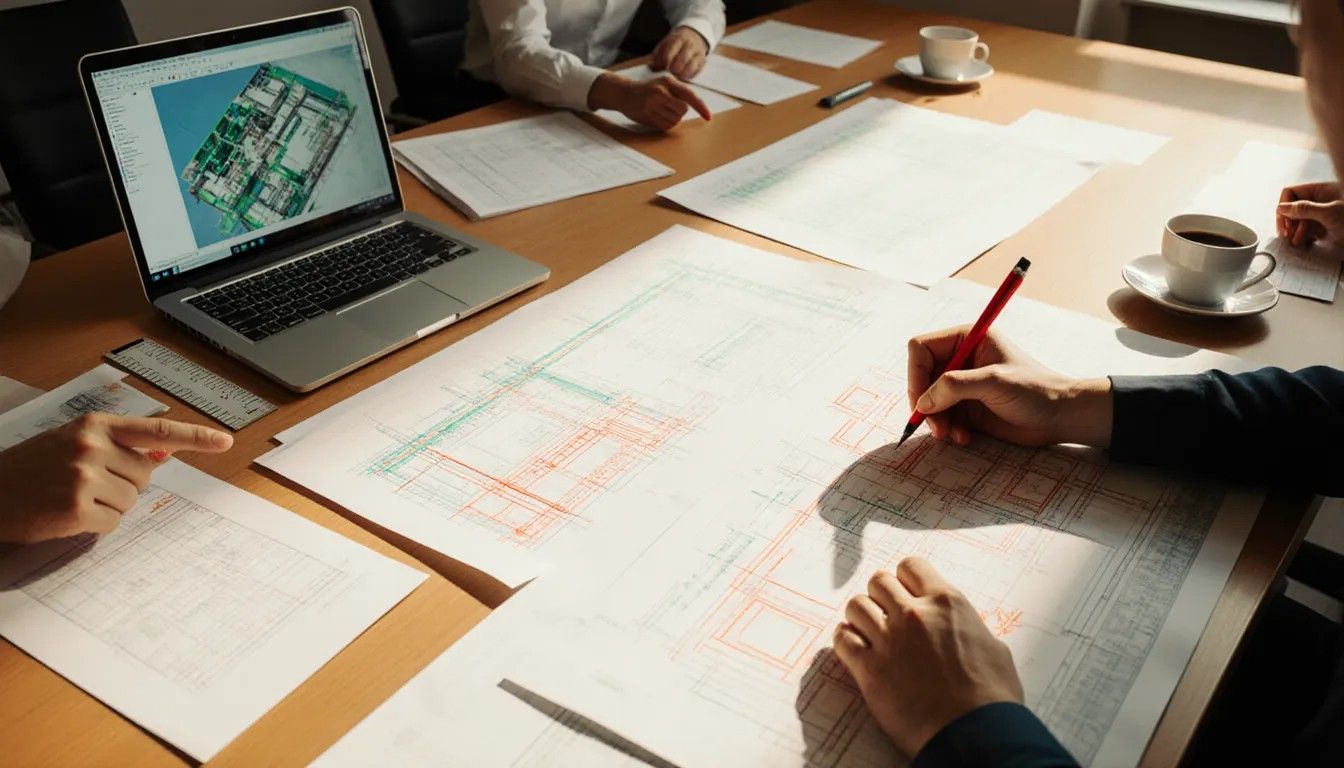
You’ve seen it happen. A process engineer moves one compressor 3 meters to the left, and suddenly your piping team is scrambling to reroute lines, structural is recalculating foundation loads, electrical is rerouting conduit, and your document controller is drowning in revision requests that all need to be issued the same week. That single equipment change just triggered updates to your plot plan, P&IDs (Process and Instrumentation Diagrams), piping isometrics, structural drawings, electrical layouts, and instrument location plans. Welcome to the cascade effect that makes layout revisions in industrial projects so challenging to manage.
Here’s what this guide delivers: a systematic approach to layout revision management that keeps your multi-discipline teams synchronized, prevents the rework that bleeds budgets dry, and protects your project timeline from death by a thousand revision cuts. You’ll learn how to build revision-control infrastructure before design begins, coordinate changes across disciplines without creating bottlenecks, use 3D model reviews strategically, and handle vendor data chaos that derails even well-planned schedules.
Why does this matter now? Because industrial capital projects keep getting more complex while timelines compress. Engineering design in Canada faces additional considerations, including provincial professional practice requirements and coordination across geographically dispersed project teams. Today’s oil and gas, petrochemical, mineral processing, and biofuels projects demand parallel engineering execution – often running 6-8 disciplines simultaneously with only 1-2 week coordination windows. Over the past four decades, revision management has evolved from paper-based transmittals to sophisticated digital workflows. The fundamentals haven’t changed, but the stakes for getting it wrong have never been higher.
Disclaimer: Project methodologies and industry standards change over time. Verify all information against current project requirements and applicable codes before implementation. For Canadian projects, ensure compliance with provincial engineering association requirements, including APEGA for Alberta-based work.
Why Layout Revisions Become Unmanageable in Capital Projects
Layout revisions in industrial projects generate complexity that most revision control systems weren’t designed to handle, they were built for single-discipline work in the 1980s. They assume one team owns a document and issues revisions in a controlled sequence – maybe 2-3 revisions over a 6-month cycle. That model breaks down in industrial capital projects where a single layout change can cascade across every discipline, generating dozens of interconnected revisions within a 2-week window.
The Cascade Effect of Equipment Changes
When your process team changes a reactor’s internals (say, switching from random packing to structured packing that changes vessel diameter by 300mm), the impact extends far beyond one equipment data sheet. That 300mm change ripples outward. Plot plan spacing needs adjustment. Pipe rack elevations shift. Structural connections require redesign. Cable tray routing changes. Instrument cable lengths need recalculating. What started as one process decision can touch documents across every discipline on your project.
This isn’t exaggeration – it’s Tuesday on a complex industrial project. On facilities like gas processing plants or petrochemical units, moving equipment even 1-2 meters requires checking maintenance clearances (typically 1.5-2.0 meters minimum for equipment removal), verifying escape routes meet safety requirements (egress distances vary by jurisdiction and hazard classification – always verify current local codes), confirming crane reach for lifts, validating pipe stress remains acceptable, and ensuring instruments remain accessible for calibration. Each check potentially triggers its own revision cascade. Layout changes late in the project can invalidate instrument calibration work already completed, adding weeks to your commissioning schedule.
Why does this happen? Industrial layouts are optimized solutions balancing dozens of competing constraints. Move one element, and all those carefully balanced constraints need rebalancing. Traditional revision control treats each discipline’s documents as independent deliverables. But in layout-driven projects, they’re interdependent nodes in a complex web. When your revision system doesn’t account for these interdependencies, you’re hoping everyone figures out coordination on their own. Spoiler: they won’t.
The Real Cost of Poor Revision Control
Here’s what typically happens without integrated workflows: Process issues a P&ID revision on Monday at 4:30 PM. Piping doesn’t see it until Friday’s distribution. They start updating the following week while electrical works off the old P&ID. Nobody discovers the conflict until the 3D model review three weeks later shows dozens of clashes between electrical and piping.
The hidden cost isn’t just the engineering hours to fix conflicts – often 40-80 hours depending on scope. It’s the schedule compression that follows, the overtime costs, and the construction delays when inconsistent documents reach the field. I’ve watched projects lose weeks because coordination happened informally rather than systematically. Extended overhead costs vary widely by project size and phase, but schedule delays on complex projects can become significant quickly.
How much does poor revision management actually cost? Costs vary significantly by project size, location, and labor rates, but field rework from outdated drawings can add up quickly. Typical examples from our experience include $5,000-15,000 for pipe support errors requiring field modification, or $8,000-25,000 for conduit rework when routing changes weren’t communicated. Add engineering hours to investigate, procurement at rush pricing, and schedule delays. On larger capital projects, we’ve seen revision management issues contribute to total rework costs in the range of 3-6% of project value – though every project’s circumstances differ.
Building Your Layout Revision Strategy Before Design Begins
Here’s an unpopular opinion: most revision problems are planning problems. Teams jump into design before establishing infrastructure for coordinated revisions, then spend the project fighting fires that 2-3 weeks of proper setup would have prevented.
Establishing Revision Numbering That Works
You’d be amazed at how many projects stumble on numbering conventions. I’ve seen projects where piping used alphabetic revisions (A, B, C), electrical used numeric (1, 2, 3), and structural used a hybrid – nobody documented this until construction asked which drawing was current.
For layout-intensive projects, I lean toward a hybrid approach: establish revision packages that group interdependent documents (all equipment arrangements in Package EA, all piping plans in Package PP), manage those packages together, and allow independent revisions for standalone deliverables. Document your convention explicitly in the Project Execution Plan and enforce it consistently.
Also, settle alpha versus numeric before work begins. Letters for preliminary revisions (A, B, C), numbers for issued-for-construction (0 for IFC, then 1, 2, 3 for field revisions). Ensure everyone understands Revision C is preliminary, while Revision 0+ means formally issued with full change management required.
Setting Design Basis Freeze Points
What should actually freeze at 30%, 60%, and 90% design completion? The 30/60/90% milestones aren’t just progress markers – they’re freeze points establishing what’s decided versus open for revision. Without clear freeze definitions, scope creep happens continuously.
At 30% completion (typically 8-12 weeks into detailed design), plot plan layout and major equipment locations freeze. Teams can optimize within established footprints, but wholesale rearrangement requires formal change authorization. By this point, you’ve invested significant hours in layout-dependent work – major changes ripple through everything.
At 60% completion (typically 16-24 weeks), equipment arrangements, major pipe routing, and structural framing freeze. Minor adjustments continue, but the fundamental layout is locked.
At 90% completion (approaching IFC), everything freezes except final detailing. Changes at this stage cost significantly more than the same change would have cost earlier – both in direct rework and schedule impact.
The authorization protocol matters as much as freeze definitions. When someone requests post-freeze changes, evaluate schedule impact, cost impact, obtain appropriate approval (discipline lead for minor, project manager for moderate, steering committee for major), and formally release affected documents. Otherwise, freezes become suggestions ignored under schedule pressure.
For Alberta-based projects, engineering review processes should align with APEGA (Association of Professional Engineers and Geoscientists of Alberta) guidelines. This includes ensuring appropriately licensed professionals review and approve design documents at each freeze point, and maintaining documentation that demonstrates professional oversight throughout the revision process. Other Canadian provinces have equivalent requirements through their respective engineering associations.
Configuring Your Document Management System
Your DMS (Document Management System – AVEVA, Aconex, ProjectWise, or SharePoint) is the backbone of revision control, but too many projects treat configuration as an IT task rather than a project execution decision.
Check-in/check-out protocols prevent concurrent editing conflicts. I’ve seen projects where multiple people edited the same CAD file simultaneously because nobody configured exclusive checkout, resulting in three different “Rev C” versions. The fix takes hours. Proper configuration takes 30 minutes during setup.
Why does exclusive checkout matter? CAD files don’t merge like text files. When two people edit simultaneously, you get two incompatible files requiring manual reconciliation. With a complex piping isometric, reconciliation often takes longer than redoing the work.
Automated distribution matrices ensure notifications reach everyone who needs them. Map out which stakeholders need which document types. Piping GA revisions go to construction, structural lead, electrical lead, and document control. Preliminary sketches stay internal. Budget adequate time during setup to build a comprehensive distribution. This isn’t glamorous work, but skipping it creates gaps that manual processes rarely catch.
Staging areas for review before official release prevent the embarrassment of issuing a document only to immediately supersede it because someone spotted an obvious error. The review period doesn’t need to be long – 24-48 hours for routine documents, 3-5 days for IFC packages – but it needs to exist.
Vista Projects specializes in implementing and configuring AVEVA’s Asset Information Management suite for exactly these purposes. The technology matters less than the thought put into configuring it for your specific workflows.
Coordinating Layout Revisions Across Disciplines
This is where the real complexity lives. When disciplines work within the same organization using connected workflows, coordination happens more naturally. When they operate as separate entities exchanging formal transmittals, coordination requires significantly more deliberate effort than most project teams anticipate.
Mapping Revision Dependencies
Understanding which disciplines lead and follow for different changes is fundamental. Process changes drive equipment data sheets. Those drive plot plans. Plot plans drive piping arrangements. Piping drives structural loads. Structural drives foundations. Each step requires the previous step to stabilize before detailed work can proceed.
But dependencies flow backward, too. When structural capacity can’t support required equipment loads, that constraint feeds back to the process. When piping stress analysis requires larger pipes that change pressure drops, piping feeds back to the process. These bidirectional dependencies require communication flowing in both directions, upstream and downstream.
Electrical and I&C disciplines deserve special attention. They depend on equipment and piping layouts while simultaneously influencing them. Instrument locations affect piping accessibility. Motor control center placement affects cable routing. These disciplines need early visibility at the 30% review stage, with enough time to provide meaningful input before layouts are finalized.
Remote I/O system planning is particularly sensitive to layout changes, as cabinet locations and cable routing directly affect installation costs.
Creating Coordination Workflows That Work
How often should teams coordinate on revisions?
Daily standups work for software development where changes are small and frequent. They don’t work as well for engineering, where a single drawing might take days to complete. But weekly coordination meetings between discipline leads, kept to 60-90 minutes and focused specifically on revision status, absolutely matter for catching conflicts before they compound.
The agenda should focus on changes: What revisions were issued this week? What’s in progress? What information is each discipline waiting for? What conflicts need resolution? Don’t let these become general status reviews – keep them focused on revision coordination.
Establish different approval authorities for different change magnitudes. Minor changes affecting a single discipline with no cost or schedule impact can be approved by discipline leads on the same day. Moderate changes crossing disciplines or affecting the schedule need a project engineer review over 2-3 days. Major changes with high cost or schedule impact need project manager approval with a formal impact assessment.
3D model coordination sessions are your best tool for catching conflicts before they become document revisions. In our experience, weekly model reviews with discipline leads consistently identify issues that would have been far more expensive to resolve later.
Integrating P&ID Changes with Physical Layout Revisions
P&IDs are the “constitution” of your plant design – everything else interprets and implements what they establish. When P&IDs are revised, physical layouts must follow. Add a new control valve, and piping needs space, structural needs to support it, electrical needs power for the actuator, and instrumentation needs signal connections.
But there’s typically a 1-3 week timing gap between when process updates the P&ID and when layout disciplines can implement changes. Managing this gap requires explicit tracking of which P&ID revision each layout document reflects. Every piping drawing should note “Based on P&ID-001 Rev D” in the title block so anyone can verify synchronization.
Without explicit basis tracking, you get drawings based on different P&ID revisions – some on Rev D, some on Rev C – with no way to identify mismatches until someone traces through every document. I’ve seen this reconciliation exercise consume weeks on projects where tracking slips.
Using 3D Model Reviews to Catch Layout Conflicts Early
3D model reviews at 30%, 60%, and 90% completion provide spatial visualization that 2D drawings cannot. You can stare at plan views all day, but nothing shows you that a 24″ pipe clashes with a cable tray like rotating a 3D model. Too many projects treat reviews as box-checking rather than strategic intervention points.
What Each Review Should Accomplish
At 30%, validate fundamental layout decisions before detailed design locks them in. Check maintenance access (typically 1.5-2x tube length clearance for exchangers, adequate space for pump removal), pipe rack capacity, safety egress distances, and cable routing separation from heat sources.
Include operations representatives whenever possible. They bring practical knowledge from years of running similar facilities that a pure engineering perspective often misses. Budget 4-6 hours for a thorough review.
At 60%, this is your last realistic opportunity for major layout changes. Run systematic clash detection (Navisworks, AVEVA Clash Manager, or similar) with appropriate tolerance settings. Vendor equipment should be represented with certified dimensions wherever available. I’ve seen single equipment items generate extensive revision cascades when certified data differed significantly from preliminary assumptions.
Include construction planning representatives. Can the planned erection sequence actually be executed? Does crane access work for heavy lifts? These questions, which are obvious to construction professionals, often never occur to engineers focused on permanent installation.
At 90%, focus on resolving remaining minor clashes, verifying construction sequencing, and confirming consistency between the 3D model, P&IDs, and construction documents. Line numbers should match exactly. Equipment tags should be consistent across all documents. Finding discrepancies at 90% is disappointing, but far better than finding them during construction.
Managing Vendor Data Exchange
Vendor data management is one of the most underestimated challenges in layout revision control. I’ve seen projects with excellent internal protocols struggle when vendor data arrived late or different from what was expected. Vendors operate on their own timeline – they’re building equipment for multiple projects simultaneously, and your project schedule isn’t their primary driver.
Planning for Late or Different Data
Vendor-certified data frequently differs from preliminary catalog data – sometimes in ways that affect layout. The percentage varies by equipment type and vendor, but it’s common enough that you should plan for it.
Build in contingency: Leave reasonable clearance margins beyond minimum requirements. Design pipe routing that can accommodate typical nozzle orientation variations. Avoid tight fits that any dimensional change would invalidate.
Establish explicit hold points: Identify equipment where layout depends on vendor-certified dimensions. Document which design activities cannot proceed without that data. When vendor data arrives, review it promptly – delays mean additional work proceeding on assumptions that may prove wrong.
Assess impact cross-discipline from the start: When mechanical receives revised pump dimensions, immediately notify piping, structural, and electrical about potential impacts. Early notification enables parallel assessment rather than sequential surprise. Factory acceptance testing provides an opportunity to verify vendor equipment dimensions before they reach the site and trigger layout revisions.
Brownfield Projects Require Different Strategies
If you’ve only worked on greenfield projects, brownfield will humble you. For engineering design in Canada, brownfield work on aging facilities is increasingly common as the industrial base matures. Existing facilities rarely match their drawings. Documents created decades ago and modified through numerous turnarounds often don’t accurately represent current conditions.
Laser scanning (LiDAR) captures existing conditions with high accuracy – typically within a few millimeters. For significant brownfield projects, scanning costs vary by scope and region, but the investment often pays for itself compared to the rework costs from proceeding with inaccurate drawings.
But scanning only captures geometry – it doesn’t identify what things are or their operating parameters. Validating drawings against field conditions requires engineer walkdowns, and the hours spent on verification generally save multiples of that time in avoided rework later.
Work with operations early to understand constraints before you design. Tie-in coordination requires precision; new construction rarely demands – flange ratings, connection sizes, and orientations must match existing conditions exactly.
Communicating Revisions to Prevent Field Rework
The best coordination doesn’t help if construction doesn’t receive the current documents. Communication breakdowns remain among the most preventable yet persistent causes of field rework.
Build effective distribution matrices answering: Who needs this document for their work? At what status level? What acknowledgment is required? Invest adequate time during setup – this administrative work prevents expensive field confusion later.
Automated distribution eliminates human forgetting. But for critical revisions affecting active construction, an explicit acknowledgment is required within 24-48 hours. Recipients should confirm that the revision has been incorporated into active work planning, not simply that the notification arrived.
For global teams spanning multiple time zones, build review routing time into your schedule. Approvals requiring input from offices 8-12 time zones apart take longer than people expect, regardless of how quickly individual reviewers respond. Use cloud-based platforms, maintaining a single source of truthSingle source of truth (SSOT) refers to the practice of structuring information models and associated data schema such that every data ele... – platform licensing costs are generally modest compared to the potential rework costs from version confusion.
Connecting Revisions to Asset Information for Operations
Engineering deliverables exist to support decades of facility operation after construction is complete. Layout revisions during engineering must feed into asset information management systems that operations will use throughout facility life.
Regulators may ask why particular layouts were chosen, especially after incidents. Future modifications depend on understanding original design constraints and the reasoning behind them. Maintenance planning relies on accurate documentation reflecting actual as-built conditions.
Plan for this during engineering. Adding consistent equipment tagging from the beginning costs incrementally more effort. Retrofitting that structure onto completed documents costs significantly more. As-built layouts should reflect final construction conditions, including field changes, fits, and as-installed configurations. Consistent tagging established during engineering carries through to your SCADA system configuration, ensuring operators see the same equipment identifiers used in design documentation.
Making Layout Revision Management a Competitive Advantage
Look, here’s what actually matters: revision management isn’t administrative overhead. It’s project execution infrastructure. Projects that invest in proper setup, run disciplined coordination, and enforce their protocols consistently outperform projects that skip these steps. The difference shows up in both cost and schedule outcomes.
The pattern is consistent. Poor revision management leads to higher rework percentages, more schedule delays from coordination failures, and more field rework from documentation errors. On a $50 million project, these issues can add up to a meaningful cost impact – potentially several percent of total project value, depending on circumstances.
Your next move? Establish protocols before design starts. Build that dependency matrix in week one. Configure your DMS properly during the first few weeks. Run weekly coordination meetings and don’t let them slide when schedules get tight.
When you need a partner who understands both engineering complexity and information management discipline, Vista Projects brings four decades of integrated engineeringThe process of integrated engineering involves multiple engineering disciplines working in conjunction with other project disciplines to e... across petrochemical, mineral processing, biofuels, oil and gas, and emerging energy markets. For engineering design in Canada, Vista Projects combines regional expertise with proven layout revision management capabilities. Our multi-disciplinary capability means revision coordination happens within our team, not across organizational boundaries. When layout revisions in industrial projects need to work the first time, that integrated approach makes the difference.
This guide is for informational purposes only and should not be considered professional engineering or project management advice. Costs, timeframes, and practices described reflect general industry experience and will vary significantly based on project size, location, labor rates, and specific circumstances. Regulations, codes, and industry standards change frequently – always verify current requirements with applicable authorities and qualified professionals before implementation.
Engineering review processes should comply with APEGA guidelines for Alberta-based projects, and with applicable provincial engineering association requirements in other Canadian jurisdictions.