

Twelve AirPlant™ One | E-Jet® SAF Commercial Plant
Overview
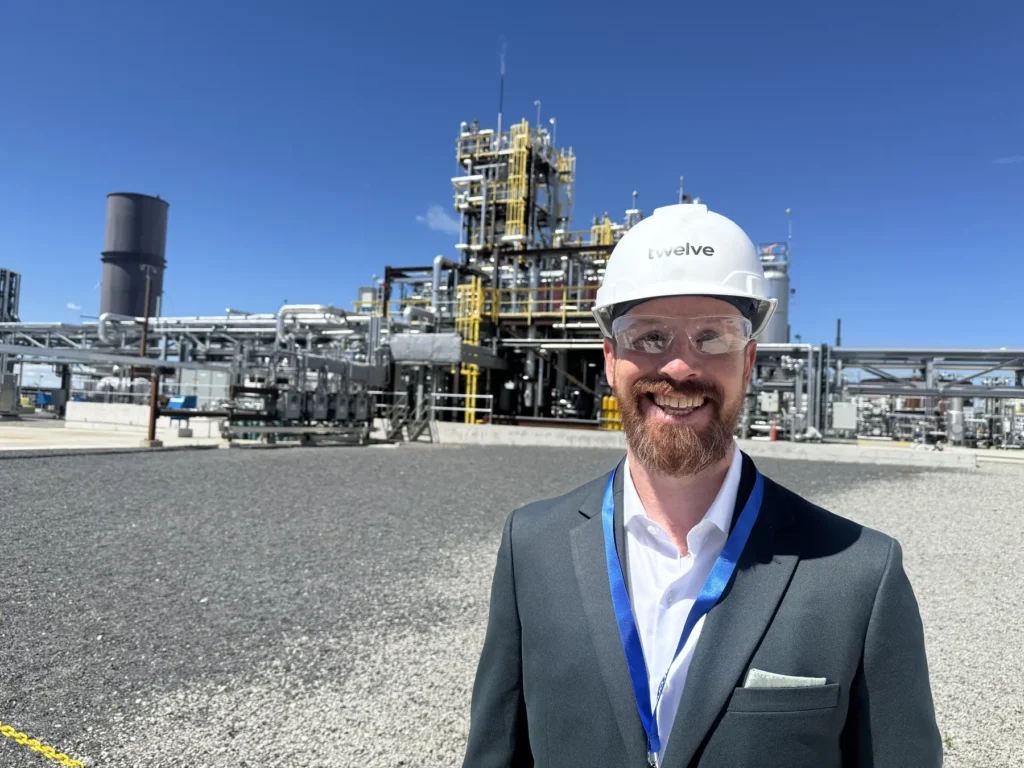
Vista Projects provided integrated engineeringThe process of integrated engineering involves multiple engineering disciplines working in conjunction with other project disciplines to exe… services for AirPlant™ One, Twelve’s first commercial eManufacturing facility and the first plant in the United States to produce E-Jet® SAF at commercial scale. Located in Moses Lake, Washington, the facility converts CO₂, water, and renewable electricity into E-Jet® SAF and E-Naphtha™ using Twelve’s proprietary power-to-liquid process. Vista supported the program through design recovery, FEED, detailed engineering, value improvement, owner’s engineering, procurement support, and on-site construction support.
The facility opened June 10, 2026, and Vista Projects’ CEO, Scott Mussbacher, was on hand for the ribbon cutting.
Project Profile
Download
Need a take away? Download a PDF of this project profile.
Client
Project/Facility
AirPlant™ One is Twelve’s first commercial eManufacturing facility in Moses Lake, Washington and the first commercial-scale electrofuel plant of its kind in the United States. Opened in June 2026, it uses renewable electricity to convert CO₂ and water into approximately 50,000 gallons per year of E-Jet® SAF.
Situation
Vista initially joined the program to establish the digital project executionDigital project execution (DPE) is a project management methodology that uses a data-centric approach to reduce project total-install-cost a… environment for the future commercial plant, while early design work for the pilot was already underway under a previous engineering partner. As Vista became more involved, a review of the pilot package revealed significant gaps in the design basis, unfinished engineering, an incomplete licensor package, and a 3D model that required substantial redevelopment. At the same time, the project was under pressure to maintain an accelerated path to start-up and demonstrate technical viability.
The challenge extended beyond incomplete deliverables and a compressed timeline. The facility was a first-of-a-kind technology configuration that combined carbon dioxide and water electrolysis, hydrogen production, and a newly licensed synthesis pathway into a single integrated pilot. For a lean, clean energy start-up without the systems or internal capacity to deliver a complex capital project at that pace, the execution risk was substantial. Vista was brought in to stabilize the work, rebuild the engineering foundation, and create a practical path to construction and commissioning.
Solution
The initial mandate quickly expanded. Vista rebuilt the design basis, integrated all process units into a coordinated 3D model, and delivered FEED and detailed engineering for a compact, highly integrated pilot facility. Using multidisciplinary engineering expertise, the team addressed equipment sizing, process simulations, thermal management, development of control systems, and utilities design needed to move the project towards execution.
To address uncertainty inherent in an emerging process, Vista worked closely with Twelve’s research teams to complete hydraulic studies, iterative design refinements and specialty modeling that improved operability and supported scale-up. In parallel, Vista also executed FEED for AirPlant™ One using the same E-Jet® SAF technology.
Outcomes
Vista applied its Value Improvement Program to streamline the layout, reduce steel quantities, simplify modularization, and eliminate redundant systems. Within the first three months, these optimizations resulted in an 8% reduction in Total Installed Cost.
As Owner’s Engineer, Vista supported capital oversight, vendor and contractor coordination, permitting guidance, quality assurance, and interface management. During construction, Vista deployed on-site engineering teams to rapidly resolve issues, maintain design integrity, and support Twelve’s internal resources. Vista’s support continued through commissioning and start-up, with AirPlant™ One brought to commercial operation on the first attempt.
Success Factors
Several factors contributed to the successful advancement of the pilot facility:
- Stabilizing inherited design work and rebuilding the engineering foundation.
- Applying value improvement and modularization strategies to reduce cost, field labor, and construction risk.
- Developing the project standards, procedures, and quality controls needed to support disciplined execution.
- Providing on-site engineering support to address technical issues in real time and maintain construction momentum.
- Collaborating with technology licensors and Twelve's research teams to align technical decisions across the facility.
Together, these efforts helped transform a fragmented early design into an integrated pilot facility with a clearer path to construction, operability, and future scale-up.
Sustainable Aviation Fuel Equipment and Technology
Vista’s engineering scope covered all major process areas, including:
- Integration of carbon dioxide and water electrolysis, hydrogen production, syngas purification, and compression systems supporting the downstream synthesis process, a newly licensed synthesis pathway to produce a jet-fuel-range product
- Product storage, transfer, and offloading facilities for finished product handling and pilot operations
- Heat tracing and thermal management for low volume operations
- Control strategies for multiple operating modes in a first-of-a-kind pilot
- Utility air, water and power systems, wastewater management strategies, and site-specific safety features
- Flare and relief systems designed to support safe startup, shutdown, and upset management
- Modular assemblies to streamline construction and reduce on-site rework
The pilot facility provided a controlled platform for proving the E-Jet® SAF process at meaningful scale, generating operating data that supported AirPlant™ One’s commercial deployment.
Engineering Applications
The capabilities demonstrated on this Twelve AirPlant™ One project apply across the clean fuels and emerging technology sectors. Vista is well suited to support start-ups and demonstration facilities that need an engineering partner capable of integrating first-of-a-kind processes, managing licensor and vendor interfaces, and providing the owner’s engineering discipline required to move through key project gates. These strengths are especially valuable for organizations developing sustainable fuels or electrochemical systems that must perform under real-world operating conditions.
Improve your project success with the help of seasoned experts

Tyler Elchuk
Business Development Director