
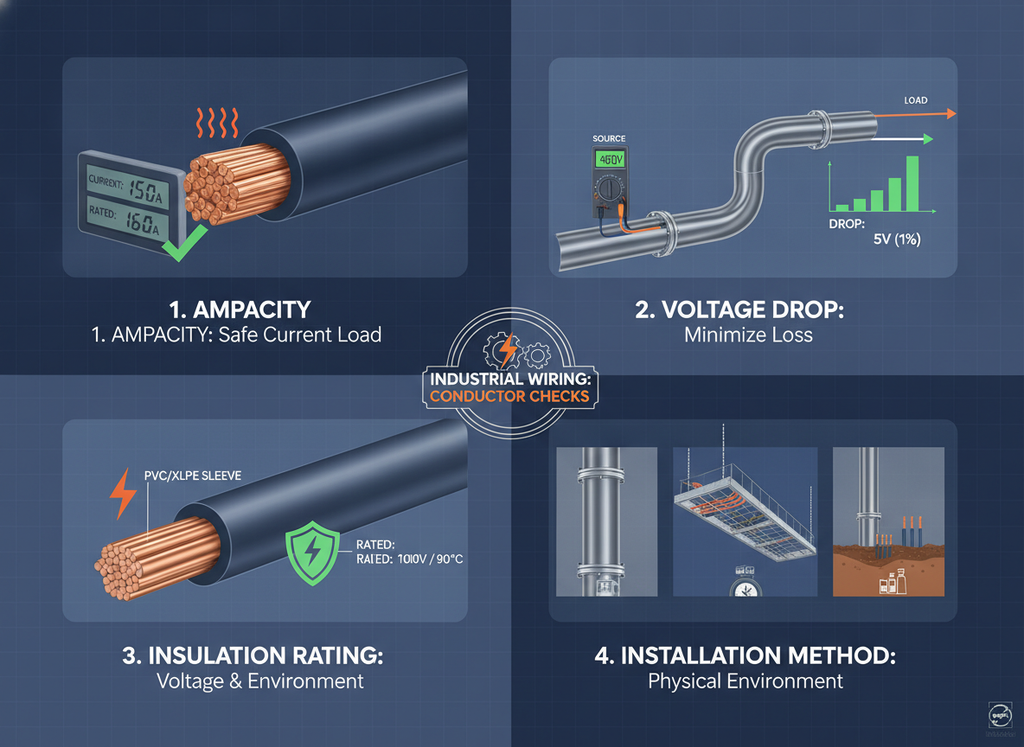
Industrial wiring is the system of conductors and cables, and the methods used to install them, that links electrical equipment in manufacturing and processing plants. It carries power to the equipment, along with the control and instrumentation signals that run the process. Compared with commercial or residential wiring, it runs at higher voltages and larger currents, often in harsh environments, and it must meet stricter hazardous-location code requirements. We check each conductor four ways. It must carry its load without overheating (its ampacity) and still deliver enough voltage at the far end after accounting for voltage drop. Its insulation rating must suit the voltage and conditions, and the installation method must suit the route. Most runs go in conduit or on cable tray, and long outdoor runs are often buried directly.
You don’t need to size conductors to work alongside the electrical team. You do need to know how the wiring is selected and installed, and which codes govern it. This article covers each, led by the Canadian Electrical Code, with U.S. equivalents for comparison.
What Is Industrial Wiring?
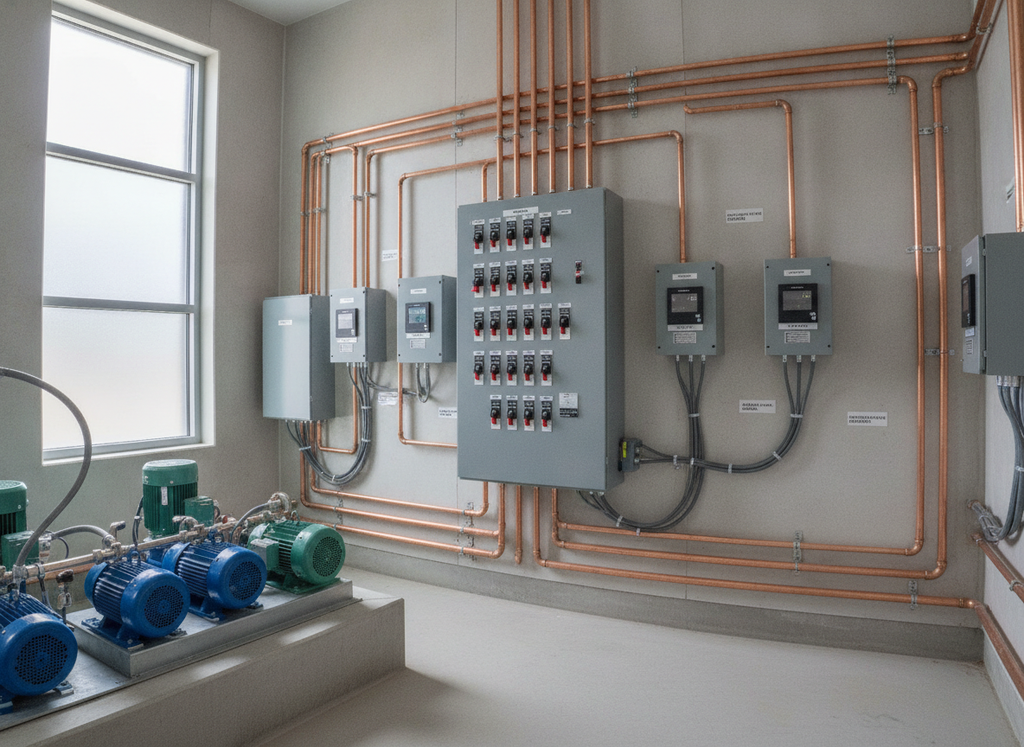
Industrial wiring, also called industrial electrical wiring, covers more than the wire. An industrial wiring system starts with the conductors, each wrapped in its own insulation and jacket. The raceways and supports that carry them are part of the system, as are the terminations at each end. Grounding and bonding conductors keep exposed metal at a safe potential and provide a path for fault current back to its source.
An industrial wiring system carries three families of circuits. Power circuits feed switchgear, motor control centres, motors, heaters and lighting. Control circuits carry start and stop commands and interlock signals, commonly at 120 V AC or 24 V DC. Instrumentation circuits carry low-energy signals, such as 4 to 20 mA loops, from field instruments to the control system. In Canada, Section 16 of the Canadian Electrical Code classifies many control and signal circuits as Class 1 or Class 2.
You’ll find industrial wiring in oil sands, gas processing, refining, petrochemical, biofuel, carbon capture and renewable energy plants, and on most of those sites the motor control centre is the hub.
Industrial Wiring vs Commercial and Residential Wiring
Industrial wiring differs from commercial and residential wiring in two ways: load size and the conditions the wiring runs through. Residential wiring runs lights and appliances on a single-phase 120/240 V supply. Commercial wiring serves the HVAC and lighting in finished buildings, mostly on three-phase systems. Industrial wiring runs large motors and process equipment at higher voltages, much of it outdoors in harsh or flammable conditions.
The industrial vs commercial wiring comparison below shows why methods built for finished buildings rarely carry over to a plant site.
| Residential | Commercial | Industrial | |
| System voltage | 120/240 V single-phase | 120/208 V three-phase, or 347/600 V (Canada) and 277/480 V (U.S.) in larger buildings | 347/600 V (Canada) or 277/480 V (U.S.), plus medium-voltage feeders at 4.16 kV, 13.8 kV or 25 kV |
| Loads | Lighting, appliances, heating | HVAC, lighting, elevators | Large motors, process heaters, compressors, drives |
| Environment | Dry, indoors | Mostly indoors | Outdoors, wet, corrosive, cold, sometimes flammable |
| Wiring methods | Non-metallic sheathed cable | EMT, armoured or MC cable | Armoured cable on tray, rigid conduit, duct banks, direct burial |
| Hazardous locations | Rare | Rare | Common in process plants |
| Design and records | Rarely engineered | Engineered on larger projects | Engineered design under a P.Eng., permits, inspection and test records |
Four Conditions Industrial Wiring Has to Handle
Industrial wiring must handle higher voltages and larger currents than building wiring, and much of it runs through harsh environments or hazardous locations.
Higher Voltages
In Canada, the standard low-voltage system for industrial plants is 347/600 V. The U.S. equivalent, 277/480 V, is also found at some Canadian sites. Larger facilities distribute at medium voltage, with 4.16 kV, 13.8 kV, and 25 kV all common. See choosing the best voltage level for factory distribution for how facilities select one.
Since its 2021 edition, the Canadian Electrical Code has defined low voltage as 31 to 1000 V AC. Earlier editions used 31 to 750 V and called anything above 750 V high voltage. For comparison, the 2026 U.S. National Electrical Code sets separate rules for systems over 1000 V AC.
Shielded medium-voltage cable needs stress-controlled terminations and splices made by qualified workers. Its insulation level, 100% or 133%, must match how fast the system clears ground faults.
Larger Currents
Starting a motor directly across the line causes it to draw roughly 5 to 10 times its full-load current, depending on motor design. Every ampere generates heat, and that heat limits how much current a cable can carry, a limit known as its ampacity. On the largest feeders, the current is high enough that the design splits it across parallel conductors.
Harsh Environments
Process facilities expose cable to conditions building wiring rarely faces. Many armoured cables, including TECK90, are rated for cold bend and impact down to −40°C, but each manufacturer sets a minimum installation temperature that may be higher, so cold-weather installation requires planning. Wet and hydrocarbon areas call for oil- and chemical-resistant jackets, and outdoor runs need sunlight-resistant ones. Where corrosion is a concern, PVC-jacketed armour and coated conduit can handle it. Cable near rotating equipment needs firm support and secure fittings to handle vibration. Electrical noise is a risk too, because variable frequency drives produce electromagnetic interference that corrupts instrument signals unless the cables are shielded and kept apart.
Hazardous Locations
A hazardous location is any area where flammable gas, vapour, dust or fibres may be present in amounts high enough to ignite.
In Canada, Section 18 of the Canadian Electrical Code uses the Zone system for new installations. Gas areas are Zones 0, 1 and 2, and dust areas are Zones 20, 21 and 22. Additions to existing sites classified under the Division system may follow Annex J18. For comparison, Articles 500–506 of the U.S. National Electrical Code permit either system. Hazardous location wiring comes with extra rules, starting with a wiring method approved for the area. That means either HL-rated armoured cable with approved glands or threaded rigid metal conduit with approved fittings. Conduit needs sealing fittings where the code specifies, and equipment must be marked for its zone or division.
Our hazardous area classification entry explains how areas are classified and how the two systems compare.
Common Cable and Conductor Types in Industrial Wiring
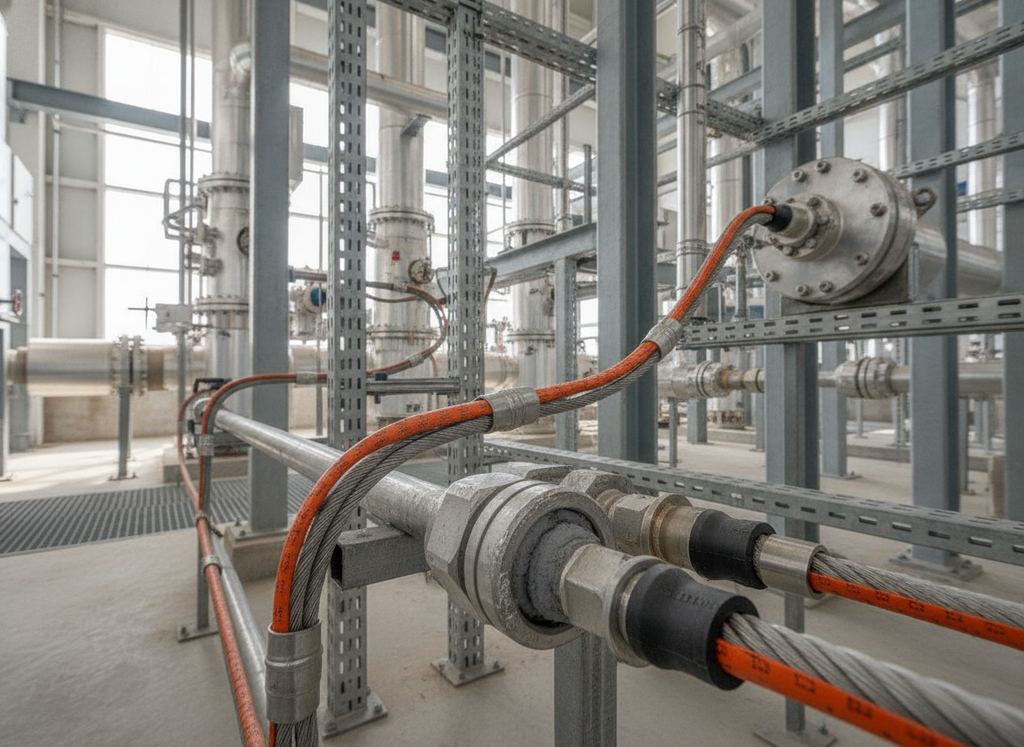
Industrial cable types come in a handful of families. Canadian projects use CSA-certified cable, and U.S. projects use UL-listed equivalents.
| Cable family | Carries | Examples | Usual installation |
| Armoured cable | Feeders and motor circuits | TECK90 and ACWU90 (Canada), Type MC and MC-HL (U.S.) | Cable tray, surface runs, direct burial where marked |
| Single conductors | Power in a raceway | RW90 and T90 Nylon (Canada), THHN/THWN-2 and XHHW-2 (U.S.) | Conduit |
| Tray cable | Power and control | TC and TC-ER (U.S.) | Cable tray, exposed runs where rated TC-ER |
| Shielded medium-voltage cable | Feeders at 5 kV to 35 kV | MV-90 and MV-105 | Cable tray, duct bank |
| Control cable | 120 V control circuits | Multiconductor armoured or tray cable | Cable tray, conduit |
| Instrumentation cable | Low-energy signals | Shielded pairs and triads, ITC and PLTC (U.S.) | Cable tray, apart from power |
| VFD cable | Drive output to the motor | Symmetrical shielded cable | Cable tray, within the drive maker’s length limits |
Copper or Aluminum
Copper suits smaller conductors and control wiring. On large feeders, aluminum alloy conductors (the AA-8000 series, for example) reduce weight and cost, though they need aluminum-rated lugs and correct torque at every termination.
Reading the Cable Jacket
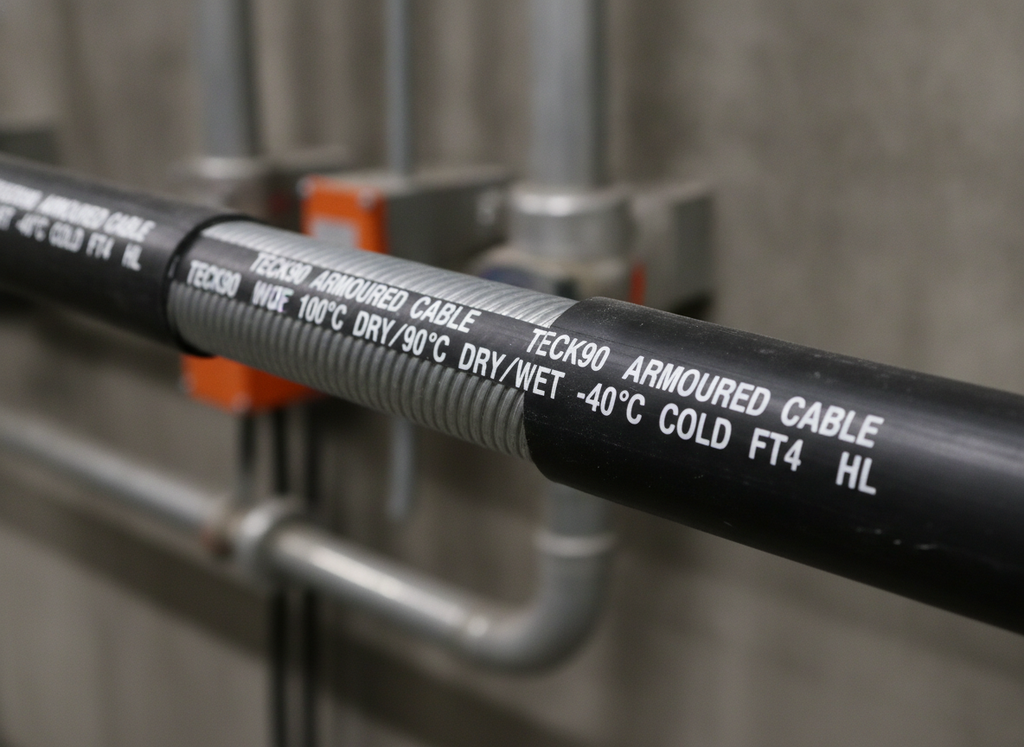
A TECK90 jacket can show the conductor size and count, voltage rating (600 V or 1000 V), temperature rating (90°C), cold rating (−40°C) and flame test (FT4). Some also carry HL for hazardous locations, and SUN RES for sunlight resistance, and cable rated for burial is marked DIR BUR. The exact print varies by manufacturer.
Keeping Signals Clean
Signal cable beside power or variable frequency drive output cable picks up noise. Design each cable type with its own space in the tray, keeping power separate from control and instrumentation, or add barriers and shielding.
Industrial Wiring Methods: Conduit, Cable Tray and Direct Burial
Industrial wiring includes three installation methods, and most facilities use all three. Each run’s method depends on how much protection it needs and what it costs, weighed against how likely the circuit is to change.
Conduit
Conduit is a protective raceway that encloses conductors or cables. In Canada, rigid metal conduit (RMC) is a common choice and provides strong mechanical protection. Electrical metallic tubing (EMT) and rigid PVC are common too, but they provide less protection.
Cable Tray
A cable tray is to cables what a pipe rack is to process piping: a shared, supported route for many runs. Trays come in ladder, ventilated trough, solid-bottom, and wire-mesh styles and carry armoured or tray-rated cable. Cable tray wiring needs design checks for support spacing, fill limits, power and instrument separation, and tray bonding. In Canada, cable tray follows Section 12 of the Canadian Electrical Code, and the U.S. equivalent is Article 392 of the NEC.
Direct Burial and Duct Banks
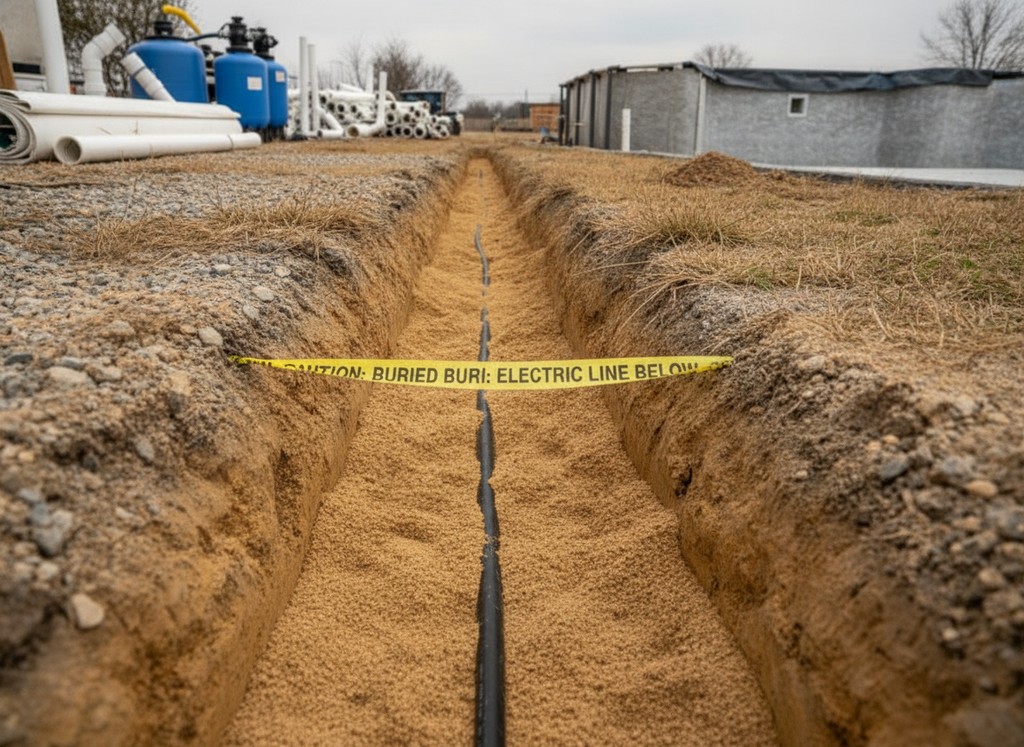
Direct-burial cable goes straight into the trench with no raceway, so only cable marked for direct burial is allowed. Its only protection is the soil above it, which is why codes set a minimum cover depth.
In Canada, Rule 12-012 of the CEC points to Table 53 for minimum cover. Guidance from the Technical Safety Authority of Saskatchewan (TSASK), for example, lists 900 mm of cover under vehicle traffic and 600 mm elsewhere for unprotected direct-buried cable. Cable that carries its own protection, whether armour like TECK90 or a conduit, can sit shallower, at 600 mm under traffic and 450 mm elsewhere, and so can cable with approved mechanical protection laid over it in the trench. For comparison, U.S. NEC Section 300.7 (numbered 300.5 before the 2026 edition) covers systems up to 1000 V. In general locations, it sets 24 in for direct-buried cable, 18 in for nonmetallic raceway listed for direct burial and 6 in for rigid metal conduit.
Backfill must be free of rocks that could cause damage. In British Columbia, for example, Technical Safety BC requires screened sand or soil with a maximum particle size of 4.75 mm. Separation from gas lines also varies, with CSA C22.3 No. 7 calling for at least 300 mm. Mark the run with warning tape or another approved marker. Road crossings and medium-voltage runs use a duct bank, a set of conduits encased in concrete that keeps the cables protected and lets crews replace them without digging.
Comparing the Methods
Each method trades protection for flexibility. Rigid metal conduit gives strong protection and suits exposed and hazardous locations, but takes the most labour. Cable tray carries many cables along shared routes at lower installed cost and accepts additions easily, though each new cable means rechecking the tray’s supports and fill and keeping power clear of instrument cable. Direct burial is the economical choice for long outdoor runs. It works only if the cable goes in at the right depth in clean backfill and someone records the route so the next crew to dig knows it’s there.
| Method | Protection | Later changes | Typical use | Watch-outs |
| Conduit | High for rigid metal, lower for EMT and PVC | Difficult | Hazardous locations, exposed areas, short runs | Labour, fill limits |
| Cable tray | Moderate, relies on the cable | Easy | Main routes along pipe racks | Support, fill, separation |
| Direct burial | Soil cover only | Excavation needed | Long outdoor runs | Cover depth, backfill, later digging |
| Duct bank | High | Cables can be replaced | Road crossings, medium-voltage feeders | Concrete cost, civil coordination |
Conductor Selection in Industrial Wiring
Conductor selection rests on four checks, each covered below, and they lean on one another. Move a cable from free air to a crowded tray and its ampacity falls. If that pushes it up a size, the voltage drop changes as well. The electrical design, completed or supervised by a licensed Professional Engineer (P.Eng.), works through all four from the electrical load list onward.
Ampacity
Ampacity is the maximum current a conductor can carry continuously without exceeding its insulation’s temperature rating. In Canada, base values come from Rule 4-004 and the ampacity tables of the Canadian Electrical Code. The U.S. equivalent is NEC 310.16. Those base values assume ideal conditions, so the design derates them when a cable runs through hot spaces or shares its route with other conductors, and again for the installation method. Where equipment terminals are rated 75°C, that rating caps the usable ampacity at the termination, under Rule 4-006 of the CEC (NEC 110.14(C) in the U.S.).
Civil engineers can think of ampacity as a pipe’s flow capacity, with derating acting as a safety factor.
Voltage Drop
Voltage drop is the voltage lost between the source and load due to conductor impedance. In Canada, Rule 8-102 of the Canadian Electrical Code sets mandatory default limits. Voltage drop can’t exceed 3% in a feeder or branch circuit, or 5% in total from the supply side of the consumer’s service to the point of use. Exceptions exist, including for industrial plants, where the design can instead keep each device within its voltage tolerance. For comparison, the U.S. NEC treats the same 3% and 5% figures as recommendations.
Voltage drop behaves like pressure drop in a pipeline, so a long run out to a well pad or a remote pump station gets sized by voltage drop rather than heat.
Insulation Rating
An insulation rating tells you what a cable’s insulation can handle, starting with voltage. Low-voltage cable is commonly rated 600 V or 1000 V, and medium-voltage cable 5 kV to 35 kV, with some rated up to 46 kV. The temperature rating sets the maximum continuous conductor temperature: 90°C for TECK90, although terminations rated 75°C or 60°C can impose a lower limit. Environmental ratings sit on top of those two. A cable headed outdoors needs its cold-impact and sunlight-resistance ratings, and one running through a hydrocarbon area needs oil resistance. FT4 confirms flame-spread performance, and HL confirms approval for hazardous locations. A cable with the right ampacity but the wrong insulation rating is still the wrong cable.
Installation Method
A conductor’s ampacity changes with its surroundings, whether free air, a crowded tray, a conduit or the ground. The method also determines the required mechanical protection and the allowed cable types. Regardless of the method, the conductor must also withstand the available short-circuit current until the protective device clears the fault.
Codes and Standards for Industrial Wiring: The Canadian Electrical Code and NEC
In Canada, industrial wiring follows the Canadian Electrical Code, Part I (CSA C22.1:24, 26th edition), which each province adopts. Alberta brought it into force on 1 April 2025 and British Columbia on 4 March 2025, and each province may add its own amendments. For comparison, U.S. states and cities adopt editions of the National Electrical Code (NFPA 70) on their own schedules, and the 2026 edition is the latest.
Canadian codes and provincial regulations take precedence for work in Canada. The U.S. column is for comparison only.
| What it covers | Canada | United States (for comparison) |
| Installation code | Canadian Electrical Code, Part I (CSA C22.1:24) | National Electrical Code (NFPA 70) |
| Product standards | CSA C22.2 series, including CSA C22.2 No. 131 for TECK90 and CSA C22.2 No. 174 for hazardous-location cables | UL standards |
| Hazardous locations | Section 18 (Zone system) and Annex J18 (Division system, existing sites) | Articles 500–506 (Division or Zone system) |
| Workplace electrical safety | Provincial OH&S legislation, with CSA Z462:24 as the consensus standard | OSHA regulations, with NFPA 70E as a consensus standard |
| Acceptance testing | ANSI/NETA ATS, plus IEEE 400.2 for shielded cable | ANSI/NETA ATS, plus IEEE 400.2 for shielded cable |
| Engineering oversight | APEGA in Alberta and other provincial regulators | State licensing boards |
| Permits and inspection | Provincial or municipal authority having jurisdiction (in Alberta, under the Safety Codes Act) | State or local authority having jurisdiction |
Some large industrial owners have another option in CSA C22.4 No. 1, the Objective-Based Industrial Electrical Code, which sets safety objectives backed by technical requirements and pairs with a safety management system manual under CSA C22.4 No. 2. Its use in place of the CEC depends on provincial adoption, so confirm with the authority having jurisdiction.
In Alberta, the Occupational Health and Safety Act, Regulation, and Code govern work on energized equipment. Our arc flash analysis entry explains how those hazards are assessed.
Where Industrial Wiring Meets Your Work
The electrical team designs the wiring, but other disciplines own much of what makes it work.
Civil engineers. You share decisions on trench routes, cover depth, backfill, duct banks and spacing from other buried services. Conduit stub-ups and grounding go in before the concrete pour. Settle cable routes before the grading plan is final.
Structural engineers. Tray weight, support spacing, deflection limits and spare capacity belong in the pipe rack and building design.
Project managers. Cable quantities follow the final routing. A late equipment or routing change hits the cable schedule first and then works its way through procurement and out to the field, where it shows up as re-pulled cable and repeat testing. For budgeting, see the cost of electrical system installation.
Site supervisors. Before a pull, check the jacket markings against the specification and confirm the cable is warm enough to install. During the pull, stay within the bend radius and pulling-tension limits, and keep power and instrument cable in their assigned trays. Label both ends before you move on.
Environmental and compliance officers. Trenching near existing plants needs checks for buried utilities. Work in classified areas needs safe work permits and, in many cases, gas testing. The compliance file should hold the permits and inspection records, along with engineering stamped by a P.Eng., who in Alberta is licensed by APEGA.
The Documents That Define an Industrial Wiring System
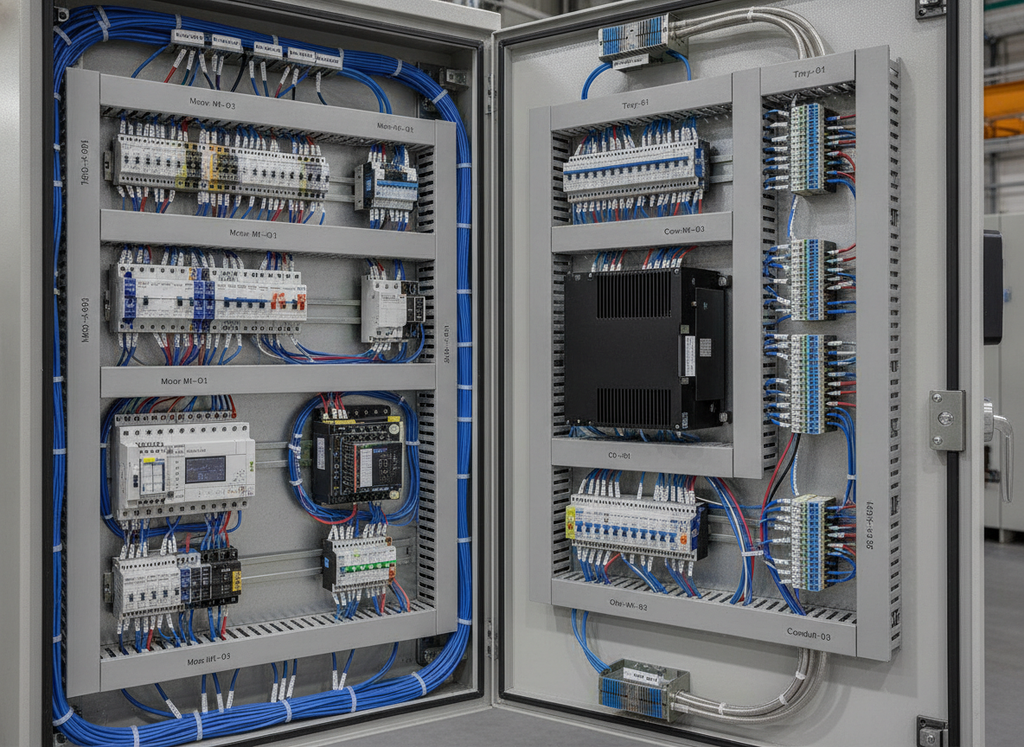
Project teams view an industrial wiring system through its documents, which build on one another. The single-line diagram shows how power flows to each load, and the electrical load list records what each piece of equipment draws. From those comes the cable schedule, which lists every cable’s tag, route, type, size and length. Tray and raceway layouts show where the cables run, and termination and interconnection diagrams show where each conductor lands. Hazardous area classification drawings mark the areas where the extra wiring rules apply. Once construction wraps up, the as-built records capture what was installed.
The cable schedule needs particular care. It’s the one document every stage of the project works from, starting with procurement’s purchase orders and ending with the copy operations inherits after startup. When a field change misses one copy, the mistake travels. It shows up first as the wrong cable on the reel, and by handover it becomes an as-built operations can’t trust.
Rework like that is costly, and poor information is behind a large share of it. In Construction Disconnected, a 2018 study by FMI for PlanGrid, surveyed construction leaders attributed 48% of rework on U.S. job sites to poor project data and miscommunication. The figure comes from U.S. research, so treat it as a guide and check it against Canadian labour rates and regulatory conditions before using it in a budget.
Field reroutes are where the copies fall apart. A crew moves a cable around a new pipe support, and on many projects that change sits on a marked-up drawing until someone updates the schedule and every copy made from it. Vista Projects stops treating the cable schedule as a set of copies. Each cable is a record in an Owner-Controlled Digital Execution Environment, the single source of truthSingle source of truth (SSOT) refers to the practice of structuring information models and associated data schema such that every data eleme... behind every wiring document, from the cable schedule to the termination diagrams. The reroute goes in once. Procurement sees the new length, and commissioning tests against the route the crew installed. Fewer wrong pulls and repeat tests mean less avoidable rework, and that’s where the savings on total installation costThe total installed cost refers to the final cost of designing, fabricating and building a capital project or industrial asset. Various phas... (TIC) come from. Operations benefits long after startup, because it inherits as-builts that match the plant, which keeps total cost of ownershipThe total cost of ownership refers to the total cost of owning an industrial asset throughout its full lifecycle, from design and constructi... (TCO) down.
Get Industrial Wiring Right Before It Reaches the Field
Testing, Inspection and Common Industrial Wiring Failures
Nothing is energized until it has been tested. Crews start by inspecting the work and confirming continuity and phasing on every circuit, then recheck termination torque. Insulation resistance testing comes next and finds damaged insulation before it fails in service. Where the project or authority having jurisdiction requires it, shielded cable rated 5 kV and above also gets a withstand test. The most common method is very low frequency (VLF) testing at 0.1 Hz under IEEE 400.2, with acceptance values taken from ANSI/NETA ATS. The authority having jurisdiction then inspects the work and logs results against the cable schedule. See motor testing before startup for motor checks.
Most failures trace back to a missed condition or selection check. A cable sized on its base ampacity, with no derating, runs hot. A long run sized for heat but not voltage drop leaves large motors struggling to start, and instrument cable laid beside a VFD or power cable picks up noisy signals. In a hazardous location, the wrong cable or an unapproved gland or seal turns the wiring itself into an ignition risk. Cold weather catches crews out too, because cable pulled below its minimum temperature cracks its jacket. The quietest failure is a field change that never makes it into the cable schedule, leaving inaccurate as-builts for whoever maintains the plant next.
For prevention, see best industrial wiring practices. For older plants, start with the steps to upgrade old plant wiring.
Frequently Asked Questions About Industrial Wiring
What is the difference between industrial and commercial wiring?
Industrial wiring serves large motors and process equipment on higher-voltage three-phase systems, much of it outdoors in harsh or hazardous locations. That’s why it relies more on armoured cable and cable tray, uses rigid conduit where it needs extra protection, and has more rigorous design and inspection requirements. Commercial wiring mainly serves lighting and HVAC in finished buildings, where those conditions rarely apply.
What voltage is used for industrial wiring in Canada?
The standard low-voltage system in Canadian industrial facilities is 347/600 V three-phase. Control circuits run at 120 V AC or 24 V DC. Larger sites distribute at medium voltage, commonly 4.16 kV, 13.8 kV or 25 kV. U.S. facilities use 277/480 V. The current Canadian Electrical Code treats anything above 1000 V AC as high voltage, while editions before 2021 used above 750 V.
What is TECK90 cable?
TECK90 is a Canadian armoured power and control cable built to CSA C22.2 No. 131. A standard build has XLPE-insulated conductors, an inner jacket, interlocking aluminum armour and an outer PVC jacket. Common ratings are 1000 V and 90°C, with cold-impact ratings to −40°C. HL versions are approved for hazardous locations under CSA C22.2 No. 174.
Does industrial wiring have to be run in conduit?
No. Much industrial wiring runs as armoured or tray-rated cable on cable tray, which costs less to install and is easier to extend. Use conduit when cables need extra protection or run as single conductors, and for hazardous-location designs that call for sealed raceways.
How deep does direct-buried cable need to be?
In Canada, Table 53 of the Canadian Electrical Code sets the minimum cover, which depends on location and protection. Saskatchewan guidance, for example, lists 900 mm under vehicle traffic and 600 mm elsewhere for unprotected cable, and 600 mm and 450 mm for armoured cable or cable in conduit. For comparison, U.S. NEC Section 300.7 sets a 24 in baseline for systems up to 1000 V. Confirm depths with the authority having jurisdiction.
Who can design and approve industrial wiring in Alberta?
In Alberta, industrial wiring design that counts as engineering must be done and authenticated under APEGA licensing. That means a Professional Engineer (P.Eng.) or another APEGA licence holder must do it, and firms need a Permit to Practice. Only master electricians can take out electrical permits as contractors. The 2024 Canadian Electrical Code has applied to installations permitted in Alberta since 1 April 2025.
Talk to Vista Before the Cable Routes Are Fixed
Many wiring problems start outside the electrical drawings. A trench gets graded too shallow, or a pipe rack goes up without room for the tray it has to carry. Sometimes a late change never makes it to the cable schedule. Raising these while the routes are still on paper keeps them from becoming rework.
Vista Projects has delivered electrical engineering services on complex capital projects for more than 40 years, under APEGA oversight in Alberta and equivalent regulators in other provinces. If wiring decisions on your next project reach past the electrical scope, bring our engineering team in before the routes are set.
Settle the Wiring Decisions Before Construction Starts
Talk to Vista’s Engineering Team
This article reflects Canadian standards and Alberta regulations, and licensing and code requirements differ in other provinces and jurisdictions. Confirm them with the authority having jurisdiction before you apply them to a project.