
In structural engineering, deep foundations are the solution when near-surface soils cannot safely support the loads of a building or facility. They transfer those loads down through weak material to competent bearing strata below. For anyone working on heavy industrial capital projects, understanding what deep foundations are, how they work, and when they’re required isn’t optional. It’s fundamental.
This article covers the core concepts behind deep foundation systems: how they transfer load to stable ground, the difference between shallow and deep foundations, and the four main foundation types used in industrial construction. It also addresses when deep foundations are required, what drives the selection between driven piles and drilled shafts, the role of geotechnical investigation, and what foundation work costs on a typical industrial project.
In Canada, deep foundation design is governed by the National Building Code of Canada (NBC) and applicable provincial building codes, with professional engineering oversight required under APEGA and equivalent provincial regulators.
Vista Projects is a multi-disciplinary engineering firm based in Calgary, Alberta, serving the energy and industrial sectors across North America. In the capital-intensive world of industrial facility design, few structural decisions carry more weight than the choice of foundation system. Getting that decision right from the earliest project phase is exactly where our team adds value.
Work With an Industry Leader
Since 1985 we have provided high-quality, fit-for-purpose engineering and system integration services to clients in a myriad of industries around the world.
What Is a Deep Foundation?
A deep foundation is a structural element that transfers loads from a building or structure downward through weak near-surface soils to competent load-bearing strata. Think dense sand, gravel, or bedrock, located well below grade. Unlike shallow foundations, which rely on the strength of near-surface soil directly beneath the footing, deep foundations bypass unstable or compressible soils entirely, extending to depths greater than 3 metres (10 feet) and often reaching 10 to 30 metres or more on challenging industrial sites.
The core engineering purpose of a deep foundation is twofold. First, to achieve adequate bearing capacity, the soil’s ability to support the imposed structural load without shear failure. Second, to limit settlement to acceptable tolerances over the life of the structure. When near-surface soils cannot satisfy either requirement, deep foundations are the solution.
Deep foundations are also called pile-supported foundations, deep foundation systems, or simply pile foundations. These terms are used interchangeably across much of Canadian practice, though distinctions exist depending on foundation type, diameter, and installation method.
Shallow vs. Deep Foundations
The fundamental distinction between shallow foundations and deep foundations comes down to where the load is transferred. A shallow foundation, like a spread footing or a mat foundation (also called a raft foundation), mobilises bearing resistance from the soil directly beneath the footing. The depth-to-width ratio is less than 4:1, and practical depths rarely exceed 2 to 3 metres. These systems are cost-effective when near-surface soils are competent and structural loads are moderate.
Deep foundations, by contrast, transfer load downward through the soil column to a stronger, stiffer layer at depth. The depth-to-width ratio exceeds 4:1, often dramatically so. The element derives its resistance from end bearing at the tip, skin friction along its embedded length, or a combination of both.
The decision between a shallow foundation and a deep foundation is not a matter of preference. It is a matter of what the soil profile and structural loads demand.
| Criterion | Shallow Foundation | Deep Foundation |
| Typical depth | Less than 3 m (10 ft) | 3 m to 60+ m |
| Load mechanism | Bearing on near-surface soil | End bearing + skin friction |
| Best suited for | Competent near-surface soils, moderate loads | Weak or compressible soils, heavy loads |
| Common types | Spread footing, mat/raft | Driven piles, drilled shafts, micropiles |
| Relative cost | Lower | Higher (justified by site conditions) |
| Settlement control | Moderate | Excellent |
How Deep Foundations Transfer Loads to the Ground
Understanding how deep foundations work starts with two primary resistance mechanisms: end bearing and skin friction. Most real-world deep foundation installations mobilise both at the same time. The relative contribution of each depends on soil profile and pile geometry.
End Bearing
End-bearing piles, also called point-bearing piles, transfer virtually all structural load through the tip of the pile into a dense, strong soil layer or rock stratum at the base. When the pile tip hits rock or very dense gravel or sand, the material provides a rigid bearing surface. The pile acts like a column. The load travels axially downward and is resisted by the high bearing capacity of the material at the tip.
End bearing is the dominant resistance mechanism when a competent stratum, dense glacial till, rock, or dense granular material exists at a practical depth below weak or soft near-surface soils. On sites where rock is encountered at 10 to 25 metres depth, end-bearing piles driven or drilled to rock can achieve very high load capacities per element, reducing the total pile count required for the structure.
Skin Friction (Side Resistance)
Friction piles, also called floating piles, develop resistance along the full embedded length of the pile through skin friction in granular soils and adhesion in cohesive soils like clay. When no hard stratum exists at a practical depth, or when the pile is embedded in a thick sequence of cohesive soils, skin friction becomes the primary source of load resistance. Sometimes the only source.
The magnitude of skin friction depends on soil type, pile surface texture, pile diameter, embedded length, and installation method. Rough-surfaced piles, like concrete piles or H-piles with attached soil, develop higher side resistance than smooth steel pipe piles in comparable soils. In practice, most piles develop resistance through both end bearing and skin friction, and bearing capacity calculations account for both contributions.
Lateral Load Resistance
Deep foundations also resist horizontal forces. Tall structures, process vessels, flare stacks, and any structure exposed to significant wind, seismic loading, or equipment-induced vibration generate lateral loads and overturning moments at the foundation level. A pile resists these forces through flexural stiffness in the upper soil zone, mobilising passive soil resistance along its embedded depth.
Deep Foundation Types: Driven Piles vs. Drilled Shafts and Other Systems
The most common deep load-bearing systems fall into four main categories: driven piles, drilled shafts, micropiles, and helical piles. Each has distinct installation characteristics, load capacity ranges, and site applicability. Selecting among them means evaluating soil conditions, structural loads, construction constraints, and project schedule.
Driven Piles
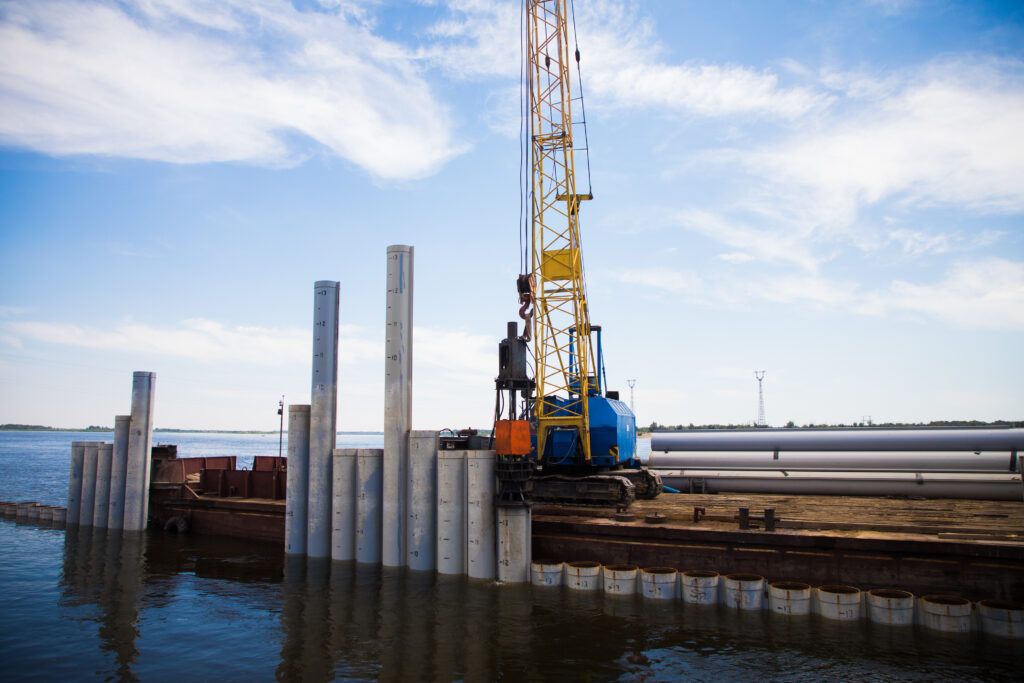
Driven piles are preformed structural elements, steel H-piles, steel pipe piles, precast concrete piles, or timber piles, installed by driving into the ground using an impact hammer, vibratory hammer, or hydraulic press. The pile is positioned at the target location and driven until it reaches the required depth or meets the specified refusal criteria. That’s the level of resistance to further penetration that confirms the pile has reached its design bearing stratum.
Steel H-piles and steel pipe piles dominate in heavy industrial applications. They tolerate hard driving without damage, achieve high load capacity, and are available in standard sections that simplify procurement. Driven piles are the most common deep foundation type on large oil sands processing facilities and industrial plants across Western Canada, where high production rates and straightforward capacity verification through driving records make them the practical default on schedule-driven projects.
Driven pile installation generates significant noise and vibration. That’s a real constraint when working near existing structures or operating facilities. Obstructions in the soil, boulders, old concrete, or buried debris can deflect or damage piles during driving. These need to be identified through site investigation before the pile schedule is finalised.
Drilled Shaft Foundations (Caissons)
Drilled shafts, also called bored piles, drilled piers, or caissons in common Canadian usage, are large-diameter reinforced concrete elements constructed in place. A rotary drilling rig bores a hole to the required depth, with steel casing used to stabilise the borehole in soft or unstable soils. A reinforcing cage is lowered into the hole, and the shaft is completed with a concrete pour from the bottom up.
A note on terminology: the word “caisson” has referred to several distinct types of structures throughout the history of foundation engineering, including the pressurised pneumatic caissons used in 19th-century bridge construction. In contemporary Canadian practice, “caisson” most commonly means a large-diameter drilled shaft. An entirely different structure. This distinction matters when reviewing older engineering literature or project specifications.
Drilled shafts generate minimal vibration during installation, making them well-suited to sites near existing structures or sensitive equipment. They can be rock-socketed, drilled directly into bedrock for a specified embedment depth, to achieve exceptionally high axial capacity per shaft. That reduces the total pile count on sites with very heavy isolated column loads. The trade-off is higher unit cost and slower installation rates compared to driven piles.
Micropiles (Mini Piles)
Micropiles, also called mini piles, are small-diameter drilled and grouted piles, 100 to 300 millimetres (4 to 12 inches) in diameter, reinforced with a central steel bar or casing. Their defining characteristic is the ability to be installed where conventional piling equipment cannot operate: inside existing structures with low overhead clearance, on steep slopes, in contaminated soils where minimising spoil volume is critical, or on remote sites with severe access restrictions.
Individual micropile capacity ranges from 200 to 2,500 kilonewtons depending on diameter, embedded length, and soil or rock conditions. Load is developed primarily through skin friction and adhesion between the grout column and the surrounding material. Micropiles are frequently used for foundation underpinning, reinforcing or supplementing the foundations of existing structures, and for new construction at locations where conventional piling is impractical.
Helical Piles (Screw Piles)
Helical piles, also called screw piles or helical piers, are steel shafts with one or more helical bearing plates welded at intervals along the shaft. Installation is achieved by rotating the pile into the ground using a hydraulic torque drive head, threading the shaft through the soil the way a screw threads into wood. No spoil is generated, installation is rapid (often minutes per pile in favourable soil conditions), and the pile can be loaded immediately after installation without a concrete cure period.
Helical piles are best suited to light and medium load applications: transmission line structures, pipeline supports, environmental monitoring installations, and light industrial structures where speed and minimal site disturbance are priorities. They are sensitive to gravel and boulders that prevent rotation and are not well-suited to very hard soils or rock. For the heavy structural loads typical of major industrial processing facilities, helical piles are generally not an appropriate primary foundation solution.
Deep Foundation Type Summary
| Type | Installation | Typical Diameter | Typical Depth Range | Best Application |
| Driven steel H-pile | Impact / vibratory hammer | 200–400 mm | 10–40 m | High loads, fast programs, hard driving |
| Driven concrete pile | Impact hammer | 250–600 mm | 10–30 m | Corrosive soils, marine environments |
| Drilled shaft/caisson | Rotary drill + concrete | 600 mm – 2.5 m | 10–50 m | Very high single loads, rock socket conditions |
| Micropile | Drill + grout | 100–300 mm | 5–30 m | Restricted access, underpinning, and remedial |
| Helical pile | Hydraulic torque | 76–350 mm shaft | 3–20 m | Light loads, fast install, no spoil |
When Are Deep Foundations Required?
Deep foundations are not a default choice. The decision to specify a deep foundation system is driven by site conditions and structural requirements that make shallow foundations inadequate or unacceptably risky.
Weak or Compressible Near-Surface Soils
Soft clays, organic soils like peat, loose fills, and saturated silts cannot support significant structural loads without excessive settlement. A standard penetration test (SPT) N-value, a common measure of soil resistance obtained during borehole drilling, below approximately 10 to 15 in the load-bearing zone, is a practical indicator that shallow foundations warrant critical scrutiny. Even when these soils can technically carry the applied stress without shear failure, the consolidation settlement that occurs as soil compresses under sustained load may be unacceptable for the structure.
Industrial equipment has a particularly low tolerance for differential settlement, the uneven sinking of a structure across its footprint. It can damage pipe connections, misalign rotating machinery, and crack structural elements. Deep foundations bypass the problem entirely by transferring load to a deeper, stiffer stratum that does not compress meaningfully under the imposed loads.
Heavy Structural Loads
A single large industrial compressor or gas turbine may impose point loads exceeding 2,000 to 5,000 kN on a single foundation pad. Shallow footings on moderate soils cannot sustain that without excessive settlement or risk of shear failure. Deep foundation systems achieve the required bearing capacity by concentrating the load at depth where competent material exists and settlement is negligible.
Lateral Loads and Overturning Forces
Tall structures, process columns, distillation towers, flare stacks, elevated platforms, and structures in seismic zones generate significant lateral loads and overturning moments at the foundation. Shallow foundations resist these forces through self-weight and base friction, which is often insufficient for tall or heavily loaded industrial structures. Deep foundations engage the surrounding soil along their full embedded depth, mobilising passive resistance that far exceeds what a shallow footing can develop.
Expansive, Collapsible, or Chemically Active Soils
Some soil types present hazards that go beyond simple bearing capacity. Expansive clays swell and shrink with seasonal moisture change, exerting heave forces on shallow foundations capable of lifting and cracking structural elements. Collapsible soils lose strength rapidly upon wetting. Chemically aggressive soils and groundwater can attack concrete and steel at shallow depths, degrading foundation elements over time. Deep foundations that extend through the active problem zone into stable, unaffected material below substantially reduce or eliminate each of these risks.
Site-Specific Constraints
Certain site conditions require deep foundations regardless of the near-surface soil quality. Foundations near open excavations or underground utilities, structures in areas with erosion-prone or unstable ground conditions, and buildings on soils susceptible to liquefaction during seismic events all require the lateral and vertical stability that only deep foundation systems can reliably provide.
Deep Foundation Design and Selection for Industrial Facilities
[Image: filename=”deep-foundation-design-industrial-facility.jpg” alt=”Deep foundation pile layout plan for a heavy industrial processing facility, Vista Projects civil engineering”]Deep foundation design is an integral part of industrial facility engineering. Not a downstream structural detail. Processing plants, SAGD (Steam-Assisted Gravity Drainage) operations, upgraders, compressor stations, and petrochemical plants all impose some of the most demanding foundation requirements of any built structure, combining heavy equipment loads, strict settlement tolerances for rotating machinery, and frequently challenging soil conditions.
Multi-disciplinary engineering teams working on industrial capital projects integrate civil engineering and structural requirements, including deep foundation specifications, with process, mechanical, piping, and electrical engineering from the earliest project phases. The Athabasca oil sands region presents particularly demanding geotechnical conditions: soft lacustrine (lake-bed) clays, variable fill over former muskeg, and organic deposits that extend well below grade. Driven steel pile foundations are the norm on virtually all major oil sands processing facilities in the region for precisely these reasons. Getting foundation decisions grounded in site-specific data and aligned across all project disciplines from the earliest phases is what separates projects that execute cleanly from those that don’t.
One of the most expensive mistakes in industrial construction is a foundation redesign triggered mid-project, when pile schedules have already been procured, structural drawings have been issued for construction, and equipment pad layouts are fixed. Changing from a shallow foundation to a deep foundation system at that stage cascades across structural, civil, piping, and construction packages. It is difficult and costly to unwind. Getting the geotechnical picture right during conceptual engineering is not a technical nicety. It protects your capital budget.
Key Factors in Industrial Deep Foundation Selection
Soil investigation findings. A site-specific geotechnical investigation must be completed before pile type selection can be committed to procurement.
In Alberta, foundation design must comply with the Alberta Building Code and the National Building Code of Canada (NBC), which establish minimum requirements for geotechnical investigation and foundation performance. Requirements vary by province. Always confirm the applicable standard with your local authority having jurisdiction (AHJ).
Load magnitude and type. Static loads from vessels and tanks, dynamic loads from rotating equipment, and vibrating loads from compressors and engines each create different foundation demands. A vibrating equipment foundation sometimes requires a dedicated machine foundation design that extends beyond pile type selection into frequency analysis and dynamic response.
Construction timeline. Driven piles install faster than drilled shafts, making them the default on schedule-critical projects. When time allows, and individual load requirements are very high, drilled shafts are worth evaluating for cost efficiency per pile.
Material availability and lead time. Large-diameter casing for drilled shafts carries procurement lead times that require early action.
Site constraints. Noise and vibration from driven pile installation can be unacceptable near existing operating facilities or sensitive infrastructure. On brownfield expansions within active plant sites, low-vibration installation methods are sometimes contractually or operationally required.
Vista Projects provides integrated multi-disciplinary engineering services for industrial capital projects across North America. If your project faces challenging foundation conditions, contact our team to discuss how early civil and structural coordination can protect your project schedule and capital budget. vi

Improve your project success with the help of seasoned experts

Tyler Elchuk
Business Development Director
The Role of the Geotechnical Investigation
No responsible deep foundation selection can be made without a site-specific geotechnical investigation. This is not a conditional recommendation. It’s a hard requirement of sound engineering practice.
A thorough geotechnical investigation for an industrial site includes rotary borehole drilling, continuous or interval soil sampling, and standard penetration testing (SPT) or cone penetration testing (CPT) to characterise soil resistance with depth. Laboratory testing of samples for strength, compressibility, and grain size, along with groundwater level characterisation, completes the field program. The output is a geotechnical report with an interpreted soil profile, bearing capacity recommendations, and preliminary pile capacity estimates. It’s the primary input to structural foundation design.
Without a geotechnical investigation, pile type selection and capacity calculations are guesswork.
For large industrial facilities, pile load testing after installation, through static load tests or dynamic pile analysis using a pile driving analyser (PDA), provides verification that installed piles achieve design capacity. This is standard practice on major projects and a critical quality assurance step that should be planned during the design phase.
Cost and Schedule Considerations
Deep foundations represent a meaningful cost premium over shallow foundation systems. That premium needs to be factored into project economics from the earliest feasibility stage, not discovered in detailed design.
As a general benchmark for the North American market, driven steel H-piles in volume run $150 to $400 per lineal metre installed, depending on pile section, site location, and project mobilisation costs. This range is indicative only. Actual costs vary significantly based on project scale, ground conditions, contractor availability, and current steel pricing.
Drilled shafts cost more per unit but are competitive when the pile count is low and individual load requirements are very high. Micropiles carry the highest unit cost of the common deep foundation types, reflecting the specialised equipment, drilling, and grouting required for their installation. The premium is justified by the access or constraint conditions that make conventional piling impossible on those projects.
For a large industrial facility, total deep foundation costs commonly represent 5 to 15 per cent of the structural budget. This varies by soil conditions, pile type, and facility size. Pile installation is a critical-path activity and must be sequenced early in the construction program to avoid delays to structural steel erection. Installation duration for a major industrial facility varies considerably depending on pile type, pile count, site access, ground conditions, and the number of rigs mobilised.
The most important cost consideration is the cost of getting the foundation system wrong. Remedial foundation work on an operating or partially constructed industrial facility costs three to five times the original foundation installation cost, plus the schedule and production losses associated with remediation.
Note: These cost benchmarks are drawn from general North American market data. Canadian project teams should validate figures against local labour rates, material pricing, regional mobilisation costs, and current market conditions before use in project estimates.
Deep Foundation Types at a Glance
The table below summarises the key characteristics of the main deep foundation types used in industrial construction and energy sector facilities. Type selection should always be grounded in site-specific geotechnical investigation findings and confirmed structural load requirements. No table can substitute for engineering judgment applied to real site data.
| Foundation Type | Install Method | Noise / Vibration | Typical Capacity | Relative Cost | Best For |
| Driven steel H-pile | Impact / vibratory | High | High | Low–Medium | Industrial plants, oil sands facilities |
| Driven concrete pile | Impact hammer | High | Medium–High | Medium | Marine, corrosive environments |
| Drilled shaft/caisson | Rotary drill + concrete | Low | Very High | Medium–High | Heavy columns, rock socket conditions |
| Micropile | Drill + grout | Low | Low–Medium | High | Restricted access, remedial, and underpinning |
| Helical pile | Hydraulic torque | Very Low | Low–Medium | Medium | Light loads, fast install, no spoil |
Frequently Asked Questions
What is the difference between a deep foundation and a shallow foundation?
A shallow foundation transfers structural load to near-surface soil at a depth of less than 3 metres, relying on the bearing capacity of the soil directly beneath the footing. A deep foundation transfers load downward through weak or compressible near-surface soils to competent material, dense soil or rock, at much greater depth, through end bearing, skin friction, or both. The choice between them is determined by soil conditions and structural load requirements. Where near-surface soils are adequate and loads are moderate, shallow foundations are the economical choice. Where they are not, deep foundations are the engineering solution.
How deep do deep foundations typically need to go?
Depth varies widely depending on where competent bearing strata are encountered and what the structural loads demand. Driven piles on industrial sites commonly reach 10 to 30 metres, extending to 40 metres or more where soft soils are deep. Drilled shafts reach 50 metres or deeper when rock socket conditions are favourable, and loads are very high. There is no universal standard depth. The required depth is determined by the site’s geotechnical investigation and the bearing capacity calculations specific to that location and structure.
How much do deep foundations cost?
Cost depends on foundation type, pile size, site location, and project mobilisation. As a general benchmark for North American industrial projects, driven steel H-piles run $150 to $400 per lineal metre installed. Drilled shafts vary widely in cost depending on diameter, depth, casing requirements, and ground conditions. Micropiles carry the highest unit cost of the common deep foundation types. For large industrial facilities, total deep foundation costs commonly represent 5 to 15 per cent of the structural budget. All ranges should be validated with site-specific quotations and current material pricing before use in project estimates.
What type of deep foundation is most common for industrial facilities?
Driven steel piles, particularly steel H-piles and large-diameter steel pipe piles, are the most common deep foundation type on major industrial processing facilities in North America, including oil sands plants, refineries, petrochemical facilities, and compressor stations. Their combination of high load capacity, fast installation, straightforward capacity verification through driving records, and wide availability of standard sections makes them the practical default on schedule-driven industrial projects where near-surface soils are inadequate and structural loads are heavy.
What is the difference between driven piles and drilled shafts?
Driven piles are preformed elements, steel H-piles, pipe piles, or precast concrete piles, hammered or pressed into the ground, with capacity verified through driving resistance at the time of installation. Drilled shafts (also called caissons or bored piles) are constructed in place: a hole is bored to depth, a reinforcing cage is placed, and concrete is cast in the hole. Drilled shafts generate less noise and vibration and achieve higher individual load capacities through rock socketing, but they install more slowly and cost more per unit than driven piles in comparable conditions.
Can you use a shallow foundation on soft soil?
Technically, shallow foundations can be used on soft soils when ground improvement techniques, like deep soil mixing, dynamic compaction, preloading, or stone columns, are applied to strengthen the near-surface material first. For heavy industrial structures where bearing capacity and settlement control requirements are stringent, deep foundations that bypass the weak material entirely are the more reliable and cost-certain engineering solution. The combined cost of a ground improvement program plus a shallow foundation sometimes exceeds the cost of a deep foundation system, particularly when deep soft deposits are present.
How long does deep foundation installation take on an industrial project?
Installation duration for a large industrial facility varies considerably depending on pile type, total pile count, site access, ground conditions, and equipment mobilisation. There is no universally applicable timeline. Driven pile programs running two or three rigs concurrently can achieve meaningful daily production rates in favourable conditions, though actual output varies considerably depending on pile length, ground conditions, site access, and equipment type. Drilled shaft programs are slower, depending on diameter and depth. Pile installation is a critical-path activity in industrial construction and must be scheduled early to avoid delays to structural steel erection and downstream construction packages.
Who designs deep foundation systems?
Deep foundation design is a multi-disciplinary exercise. In Alberta, professional engineering services are delivered under the oversight of APEGA (Association of Professional Engineers and Geoscientists of Alberta), with equivalent regulators governing practice in other provinces. The geotechnical investigation and bearing capacity analysis are performed by an APEGA licensed geotechnical engineer (P.Eng.). The structural design of the pile, section selection, capacity verification, and connection details are the responsibility of the structural engineer of record (P.Eng.).
On industrial projects, the foundation designer also requires accurate load inputs from the mechanical and process engineers responsible for equipment selection and layout. On complex capital projects, a multi-disciplinary engineering firm coordinates these inputs across disciplines to ensure that foundation design reflects actual equipment loads from project outset, and is not revised at significant cost mid-execution.
Getting Foundation Decisions Right
Deep foundations are one of the most consequential structural decisions in the design of any heavy industrial facility. When surface soils are weak, compressible, or otherwise unsuitable, and when structural loads are heavy, dynamic, or sensitive to settlement, pile-supported foundations are not a premium upgrade. They are the only path to a structure that performs as intended over its service life.
The choice among driven piles, drilled shafts, micropiles, and other deep foundation systems is never arbitrary. It reflects a specific intersection of soil conditions, structural loads, construction constraints, and project schedule.
Vista Projects aligns civil and structural engineering requirements with the broader project scope from day one. We support industrial capital projects from conceptual engineering through detailed design. Foundation decisions made in pre-FEED, with full geotechnical and structural coordination, protect both the structural integrity of the facility and the economics of the capital project. Those made late, or left to resolve themselves in the field, do neither. All engineering work adheres to Canadian codes and provincial standards, with licensed P.Eng. oversight across civil, structural, and geotechnical disciplines.
If you are planning a new industrial facility, evaluating a site expansion, or working through a capital project with uncertain ground conditions, our multi-disciplinary engineering team can help ensure your foundation requirements are addressed from the earliest project phase. Contact us to discuss your project.
Certifications and licensure requirements vary by jurisdiction. This article reflects Canadian standards and Alberta provincial regulations. For projects in other provinces or jurisdictions, verify requirements with the appropriate provincial authority having jurisdiction.