
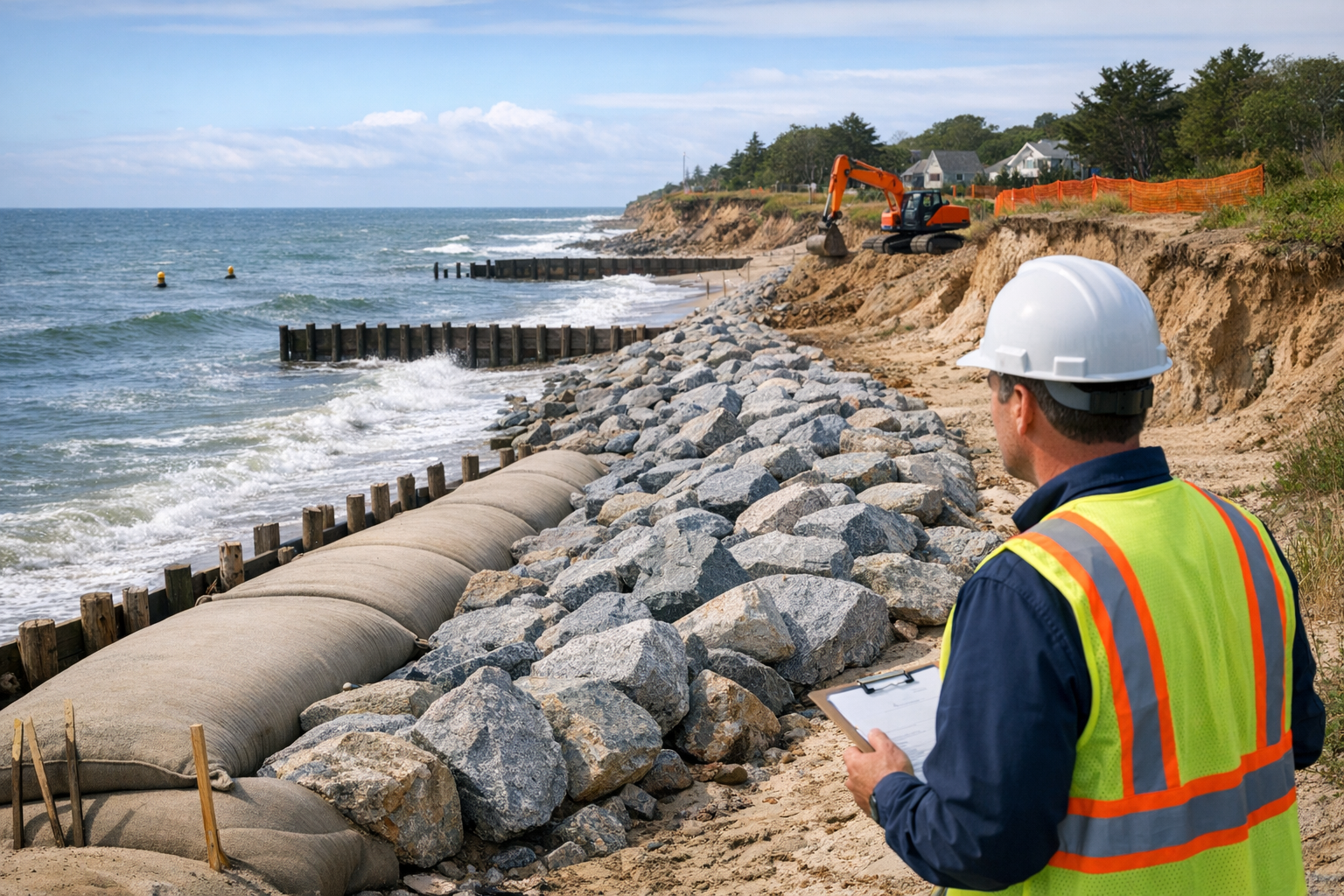
Coastal erosion management is the structured practice of assessing, planning, and implementing strategies to slow, redirect, or adapt to land loss along shorelines, also called shoreline erosion control, coastal protection engineering, or shoreline stabilisation. Three primary variables determine which approach is right for any specific site: wave energy regime, sediment budget status, and the value and design life of the assets at risk.
While Vista Projects’ core portfolio centers on heavy industrial facilities and energy infrastructure, the same civil, structural, and environmental engineering capabilities apply directly to industrial assets located in coastal or high-erosion-risk environments.
Here is how failures play out. A groyne field gets installed on a sandy coast without a completed sediment budget assessment. It traps sediment on the updrift side, exactly as designed. But the beach two kilometres downdrift starts losing sand at an accelerated rate within three years. A second intervention is proposed. Then a third. The original structure performed exactly as intended, and the project still generated significantly more remediation spend than the original installation cost, in some cases, multiples of the original project value. One incomplete site characterisation. Three cascading failures.
This article explains what drives erosion across different coastal environments and how the three primary strategy categories (hard engineering, soft engineering, and managed retreat) differ in application, cost, and failure modes. It introduces the Site-Risk Selection Framework: the four-variable decision logic engineers use to match strategy to site conditions. For engineers, infrastructure owners, and capital project teams working near coastlines, this is the foundation for defensible, cost-effective decisions.
Working on a capital project near a coastal or high-erosion-risk site? Talk to a Vista Projects civil engineer about site integrity assessment.
Disclaimer: Certifications and licensure requirements vary by jurisdiction. This article reflects Canadian standards and Alberta provincial regulations. For projects in other provinces or jurisdictions, verify requirements with the appropriate provincial authority having jurisdiction. All cost figures are indicative estimates. Validate against site-specific conditions before budgeting. This information is educational. Consult a licensed P.Eng. for project-specific engineering and compliance work.
At a Glance: Coastal Erosion Management Strategies
Two tables are used below for mobile readability.
Table 1: Strategy Overview
| Strategy | Primary Mechanism | Typical Application |
| Seawall | Reflects and absorbs wave energy | High-energy industrial and energy sector coastlines |
| Groyne | Traps longshore sediment transport | Sandy drift-dominated coasts |
| Revetment | Armours slope against the wave attack | Embankments, bluffs, estuarine edges |
| Breakwater | Dissipates wave energy offshore | Harbours, ports, near-shore facilities |
| Beach Nourishment | Adds sediment to the eroding beach | Sandy beaches, lower-energy coasts |
| Dune Restoration | Builds a natural sediment buffer | Low-energy shorelines, ecological zones |
| Managed Vegetation | Root systems stabilise soil and sediment | Estuaries, tidal flats, riverine coasts |
| Managed Retreat | Asset relocation away from the erosion zone | Long-term high-risk or undefendable sites |
| Hybrid Approach | Combines hard and soft methods | Complex or high-value sites |
Table 2: Cost and Risk Profile
| Strategy | Indicative Capital Cost (CAD) | Maintenance Frequency | Key Risk If Misapplied |
| Seawall | $3,000-$15,000+ per linear metre | Inspection every 5-10 years | Foundation scour; downdrift erosion |
| Groyne | $500,000-$5M+ per structure | Monitoring every 2-3 years | Sediment starvation of adjacent beaches |
| Revetment | $1,500-$8,000 per linear metre | Inspection every 3-5 years | Undermining if toe protection is absent |
| Breakwater | $10M-$100M+ depending on scale | Periodic storm damage checks | Altered sediment transport patterns |
| Beach Nourishment | $5M-$15M per kilometre per cycle | Replenishment every 3-10 years | Rapid loss if sediment budget not assessed |
| Dune Restoration | $50,000-$500,000 per project | Vegetation management annually | Slow establishment; storm vulnerability |
| Managed Vegetation | $20,000-$200,000 per site | Annual monitoring and replanting | Limited to lower-energy environments |
| Managed Retreat | Variable (relocation and decommission) | None post-relocation | Requires a 10-20 year planning lead time |
| Hybrid Approach | Higher than either approach alone | 2-5 year review cycles | Component coordination failure |
Cost figures are indicative estimates drawn from U.S., UK, and Australian coastal management case study data, converted to approximate CAD equivalents. Canadian costs vary significantly by site access, material availability, and labour market.
All cost figures are high-level international benchmarks and must be validated under Canadian geotechnical conditions, regulatory frameworks, and labour markets. These international sources are provided for context only and do not represent Canadian design standards or regulatory frameworks.
What Is Coastal Erosion Management?
Coastal erosion management is the structured practice of assessing erosion risk, selecting appropriate intervention strategies, implementing those strategies through engineering design, and monitoring their performance over time. Effective coastal erosion management integrates physical structures, planning frameworks, environmental assessment, sediment budget management, and long-term adaptive monitoring as a coordinated programme, not as separate activities.
The scope runs from the geotechnical site investigation that identifies substrate conditions beneath a vulnerable shoreline, through wave climate analysis that defines the energy envelope a structure must withstand, to the monitoring programme that tells you five years post-construction whether the strategy is performing or quietly failing. Engineering work in this domain falls under the oversight of professional engineering regulators, including APEGA, the Association of Professional Engineers and Geoscientists of Alberta, and equivalent provincial bodies. Any structural coastal works or geotechnical analysis of erosion-prone sites in Canada requires a licensed P.Eng.
We will cover what drives erosion and why understanding the cause matters before any strategy is selected in the next section.
What Causes Coastal Erosion?
Not all coastal erosion is the same. Treating it as a single phenomenon is where many management strategies start going wrong, and where project teams end up applying what looks like a straightforward hard structure solution to a problem that was substantially self-inflicted by upstream human decisions.
Natural Erosion Drivers
Wave action, tidal fluctuation, and storm surge erode rock, soil, and sediment at the waterline through hydraulic stress (direct water pressure) and abrasion (sediment particles carried by waves grinding down the shoreline). Littoral drift is the movement of sediment along a coast driven by oblique wave strike. It redistributes material constantly, creating accretion in some locations and net loss in others.
A shoreline losing one to two metres per year under normal conditions can lose many times its annual average in a single severe storm event. That is the difference between a chronic management programme and an acute emergency. Sea level rise compounds every other driver: as baseline water levels rise, storm events reach further inland, and the erosion zone migrates landward. Natural Resources Canada and Environment and Climate Change Canada publish regional sea level rise projections that Canadian engineers should be building into design life assumptions now, not retrofitting after construction.
How Human Activity Accelerates Erosion
A significant portion of accelerated coastal erosion originates kilometres inland, not from the sea. Research suggests that river damming can substantially reduce the natural coastal sediment supply downstream by 40 percent or more, depending on dam scale and location. Coastal development removes dune systems that would otherwise buffer the shoreline. Hard structures installed without system-level sediment budget analysis (a full quantitative accounting of sediment inputs, outputs, and transport pathways across the coastal cell) trap material in one location while starving adjacent beaches.
For comparative context, the U.S. Climate Resilience Toolkit reports that coastal erosion costs the U.S. approximately $500 million USD per year in property loss, driven substantially by the compounding effects of prior interventions that ignored sediment dynamics. Canadian cost profiles differ. Validate against domestic conditions before using U.S. benchmarks in project budgeting.
Structural vs. Incidental Erosion: Why the Distinction Matters
Structural erosion (chronic long-term shoreline retreat driven by a persistent sediment deficit) and incidental erosion (storm-induced acute retreat followed by partial natural recovery) require fundamentally different responses.
The right response to incidental erosion is frequently to wait. A beach that loses three to five metres in a single storm and naturally recovers a substantial portion of that loss within six to twelve months does not need a seawall. Installing one triggers downdrift sediment starvation, adds $3,000 to $15,000 per linear metre in capital cost, and solves a problem the natural system was already handling. Conflating the two is one of the most reliable routes to over-engineered, underperforming outcomes.
The type of erosion present directly determines which strategies are viable. We return to this point in the Site-Risk Selection Framework below.
Shoreline Stabilisation Strategies: The Three Main Approaches
The Coastal Wiki’s technical overview of shore protection measures documents these categories in depth. What follows is the decision-making context that technical literature consistently skips: the trade-offs that determine whether a given approach belongs on your site. Strategy selection logic is covered in full in the next section.
Hard Engineering: Holding the Line
Hard engineering uses physical structures to resist wave energy and hold the shoreline in its current position. The primary tools are seawalls, groynes (walls perpendicular to shore that trap longshore sediment transport), revetments (sloped armour layers protecting embankments and bluffs), and breakwaters (offshore structures that dissipate wave energy before it reaches shore).
Seawalls for industrial applications run $3,000 to $15,000 CAD per linear metre installed. A 500-metre scheme reaches $1.5M to $7.5M before engineering and permitting. Maintenance requirements are comparatively low. The trade-off is physics: hard structures protect what is directly behind them and frequently accelerate erosion downdrift by interrupting natural sediment transport. That outcome must be quantified through sediment transport modelling before any hard structure goes in.
Hard engineering is the right call on high-energy coastlines protecting high-value, long-life assets where the sediment budget is compromised and soft approaches are not technically viable.
Soft Engineering: Working With Natural Processes
Soft engineering works with natural coastal processes rather than against them. Beach nourishment (adding imported sediment to restore an eroding beach profile), dune restoration (rebuilding natural sediment buffers through vegetation establishment), and managed vegetation (stabilising soil through root systems in lower-energy environments) are the primary tools.
Beach nourishment for a one-kilometre frontage runs approximately $5M to $15M CAD per replenishment cycle, with replenishment required every three to ten years as placed sediment migrates through the same littoral system that caused the original erosion. Soft engineering works best where natural sediment supply is adequate, wave energy is moderate, and the management objective is compatible with sustained maintenance investment across the full asset design life.
Managed Retreat: Planning for Long-Term Change
Managed retreat is the planned relocation of assets away from high-risk erosion zones, allowing natural coastal processes to operate without ongoing intervention. In an industrial engineering context, this means strategic asset relocation or buffer zone planning, not community displacement.
This is not a failure of engineering. Where long-term erosion rates exceed one to two metres per year and hard engineering costs would exceed asset value within the operational life, managed retreat is often the most defensible strategy available. The constraint is lead time: complex industrial assets require ten to twenty-year planning horizons for phased decommissioning, approvals, and replacement. The conversation belongs at project feasibility.
How Engineers Choose a Coastal Erosion Management Strategy: The Site-Risk Selection Framework
This is the section no one writes about. Every article on coastal erosion management describes what the three strategy categories are. Not one explains how professionals decide between them for a specific site. That selection step is where most coastal erosion management failures originate, not in the construction, not in the engineering design itself, but in the absence of a structured selection process before either begins.
The Site-Risk Selection Framework organises that decision around four variables. Get all four right, and strategy selection follows logically from the site data. Shortcut one, and you are building on an incomplete foundation that will cost substantially more to fix than the shortcut saved.
The Four Selection Variables
Variable 1: Wave energy regime (the intensity and frequency of wave forces acting on the shoreline). High-energy coastlines, where significant wave heights (the average of the highest one-third of waves) regularly exceed one to two metres, favour hard engineering. Lower-energy environments, estuaries, and sheltered bays where significant wave heights stay below 0.5 metres, are viable candidates for soft engineering and managed vegetation. Getting this wrong in either direction is expensive.
Variable 2: Sediment budget status (a full quantitative accounting of sediment inputs, outputs, and transport pathways across the coastal cell). Where ongoing sediment supply is adequate, beach nourishment and dune restoration are viable. A sediment-starved coast will defeat soft engineering regardless of design quality. Budget assessment typically takes four to eight weeks and, depending on site complexity and data availability, costs in the range of $50,000 to $150,000 CAD, though this is highly variable by project. A $100,000 assessment that prevents a $10M nourishment failure is the best-returning investment at the early-project stage, every time.
Variable 3: Asset value and design life. A coastal energy facility with a twenty-five-year operational life and $200M replacement value warrants a fundamentally different protection analysis than a temporary access road. When protection costs over the asset’s remaining life exceed 40 to 60 percent of the asset’s replacement value, managed retreat deserves serious evaluation.
Variable 4: Regulatory and environmental constraints. Protected habitat designations, federal thresholds under the Impact Assessment Act, provincial setback regulations, and approval timelines all shape what is viable. Environmental assessment for significant coastal works in Canada typically takes twelve to thirty-six months from application to decision under current federal and provincial frameworks. That constraint must be factored before design begins, not after.
What Goes Wrong When the Wrong Strategy Is Chosen
The cascade is predictable. Every one of these failures is an information problem, not an execution problem.
A groyne field on a sediment-deficient coast traps what little available sediment exists updrift. Erosion accelerates downdrift, often substantially faster than the pre-groyne baseline. A second structure is proposed. The original performed exactly as designed. It was the wrong selection for that site. Documented remediation costs in cases of this failure type run to multiples of the original project value.
A seawall without adequate toe protection (the armoured base layer that prevents wave scour from undermining the foundation) can begin to scour its foundation well within the structure’s intended design life under repeated storm loading. Emergency remediation runs $2,000 to $5,000 per linear metre. The toe protection layer at construction costs $300 to $800 per linear metre. Omitting it saves money on day one and costs many times more to fix under emergency conditions.
Beach nourishment on a high-energy coastline without a sediment budget assessment can disappear within a fraction of the projected five-to-ten-year design life, in some cases, within a single storm season on high-energy coastlines. Documented total lifecycle spend over twenty years in cases of this failure mode runs significantly higher than what a properly site-characterised strategy would have required.
Every coastal erosion management failure we have seen traces back to one skipped step: characterising the sediment budget before selecting the strategy.
A full site characterisation programme covering wave climate analysis, sediment budget assessment, erosion rate history, geotechnical investigation, and regulatory constraint mapping typically costs in the range of $150,000 to $400,000 CAD for a typical industrial coastal site. However, scope, access, and data availability drive significant variation, and it takes three to six months. That investment preventing a $10M to $40M remediation programme is, without exception, the best-returning early-stage spend on any capital project with coastal exposure.
Need help evaluating site conditions for a near-shore or environmentally exposed capital project? Request a project scoping conversation with Vista’s engineering team.
Coastal Erosion Management and Industrial Infrastructure
Near-shore energy facilities, ports, pipelines, and industrial embankments all carry material erosion risk, and most of it gets addressed reactively, after visible damage, rather than as a structured element of project feasibility.
Emergency contractor mobilisation for an embankment failure typically carries a significant cost premium over equivalent planned works. The same remediation scope that costs $500,000 planned commonly reaches $750,000 or more on an emergency basis, and that is before production disruption, regulatory notification, and reputational exposure are factored in. Erosion risk assessment belongs in capital project site characterisation from the earliest feasibility stages, not in the emergency response budget.
The key technical interfaces for industrial coastal sites are geotechnical site investigation (substrate conditions for both foundation design and erosion susceptibility), wave and flood climate analysis (the energy envelope across the full design life), and long-term shoreline change rate assessment, which defines where the erosion zone will be in year ten, year twenty-five, and year fifty.
Canadian Regulatory and Professional Engineering Considerations
Professional engineering work related to coastal erosion management in Canada is regulated at the provincial level, and requirements are not uniform across jurisdictions.
APEGA governs P.Eng. licensure in Alberta. Engineers Nova Scotia, Professional Engineers Ontario, Engineers and Geoscientists British Columbia, and equivalent bodies govern other provinces. Design of coastal protection structures, geotechnical assessments for near-shore capital projects, and structural analysis of near-shore industrial facilities all require a licensed P.Eng. This is a legal requirement, not a formality.
At the federal level, coastal works meeting certain thresholds trigger review under the Impact Assessment Act. In Alberta, the Alberta Energy Regulator (AER) has jurisdiction over certain near-water energy infrastructure. Environmental assessment typically runs twelve to thirty-six months from application to decision under current federal and provincial frameworks. Factor that timeline into project scheduling before design begins. Regulatory requirements in this area continue to evolve, so always verify current obligations with the authority having jurisdiction for your specific project before design begins.
Certifications and licensure requirements vary by jurisdiction. This article reflects Canadian standards and Alberta provincial regulations. For projects in other provinces or jurisdictions, verify requirements with the appropriate provincial authority having jurisdiction.
Where Coastal Erosion Management Is Headed
Three trends are reshaping how shoreline erosion control operates, all three with direct implications for engineers specifying coastal works with design lives extending into the 2040s.
Continuous Monitoring via LiDAR and Remote Sensing
Periodic manual survey is being replaced by airborne LiDAR (Light Detection and Ranging, a laser-based method producing millimetre-accurate three-dimensional shoreline models), drone photogrammetry, and automated satellite-based change detection. Survey costs have decreased significantly over the past decade. Surveys that once required substantial capital investment are now accessible at a fraction of the earlier cost, and adaptive management decisions now run on six-to-twelve-month cycles rather than five-year intervals.
Nature-Based Solutions Gaining Approval and Funding Momentum
Federal climate adaptation programmes under Environment and Climate Change Canada are increasingly prioritising nature-based solutions. These approaches use or restore natural coastal features like marshes, dune systems, and beach morphology. Projects with genuine NbS consideration move through federal environmental assessment more efficiently and qualify for federal funding streams unavailable to conventional hard-engineering proposals.
Climate-Adjusted Design Life Assumptions
The fifty-year and one-hundred-year storm return period assumptions underpinning most Canadian coastal engineering standards are being formally reassessed. Natural Resources Canada projects sea level increases of 0.3 to 1.0 metres by 2100 across Canadian coastal regions. A structure designed for today’s 100-year flood event may provide only 50-year-equivalent protection by mid-century. Engineers specifying coastal works with design lives past 2050 face a growing obligation to incorporate projected sea level rise into the design basis from day one.
Frequently Asked Questions About Coastal Erosion Management
How long does a coastal erosion management strategy take to show results?
Hard engineering protection is immediate on the day construction completes. Beach nourishment restores beach width quickly after placement but requires replenishment every three to ten years as placed sediment migrates through the littoral system. Dune restoration through species like marram grass (Ammophila borealis) takes two to five years for root systems to mature and provide meaningful storm protection. Managed retreat for industrial assets unfolds over ten to twenty-year planning horizons.
How much does coastal erosion management cost in Canada?
Seawalls for industrial applications run $3,000 to $15,000 CAD per linear metre installed. Beach nourishment costs approximately $5M to $15M CAD per kilometre per cycle. Managed retreat cost is driven by asset relocation and decommissioning complexity. For context, the U.S. Army Corps of Engineers cites $5M USD per mile as a U.S. nourishment average. Canadian costs differ significantly based on local sediment availability, labour markets, and site access. Get competitive pricing and a site-specific assessment before committing to any budget.
What is the difference between hard engineering and soft engineering in coastal management?
Hard engineering (seawalls, groynes, revetments, breakwaters) resists wave energy with physical structures. Soft engineering (beach nourishment, dune restoration, managed vegetation) absorbs erosive forces within a dynamic coastal system. Hard engineering carries higher capital costs and lower ongoing maintenance. Soft engineering is the reverse: lower capital, higher lifecycle maintenance. On complex or high-value sites, hybrid approaches typically outperform either alone. See the summary tables above for a full cost and risk comparison.
When is managed retreat the right strategy?
When long-term erosion rates assessed over a ten to thirty-year data record make permanent defence economically non-viable. When protection costs over the remaining asset life exceed forty to sixty percent of replacement value. When hard defences would transfer the erosion problem to adjacent infrastructure. The conversation must happen at project feasibility. Managed retreat requires a ten to twenty-year planning lead time and cannot be implemented reactively.
Do I need a professional engineer for coastal erosion management work in Canada?
Yes, for any substantive scope. Design of hard coastal structures, geotechnical assessment of erosion-prone sites, and structural analysis of near-shore industrial facilities require a licensed P.Eng. under provincial engineering acts. This applies under APEGA in Alberta and equivalent bodies across all provinces. Engage a P.Eng. at the feasibility stage, not after preliminary design. For more on what professional engineering oversight looks like on a capital project with coastal exposure, see our project services.
What are the most common reasons coastal erosion management strategies fail?
Incomplete site characterisation before strategy selection is the root cause in the majority of documented cases, specifically missing sediment budget analysis, insufficient wave climate data, and absent long-term erosion rate history. Other failure modes follow in rough order of frequency. Undersized hard structures fail under storms more severe than the design event. Hard defences get installed without modelling downdrift sediment effects. Soft engineering gets applied to sediment-starved coastlines. And erosion management gets treated as a one-time installation rather than an adaptive programme. The Site-Risk Selection Framework addresses each of these through its four-variable assessment sequence.
How does sea level rise affect coastal erosion management planning for Canadian industrial assets?
It shortens effective design life and increases required protection standards over the asset’s operational period. A structure designed for today’s 100-year flood event may provide only 50-year-equivalent protection by mid-century. Natural Resources Canada projects sea level increases of 0.3 to 1.0 metres by 2100 across Canadian coastal regions. Engineers specifying works with design lives past 2050 must incorporate those projections into the design basis from the outset, not retrofit them later.
Conclusion
Coastal erosion management is a chain of connected decisions, not a menu of standalone options. Site characterisation determines which strategies are viable. Strategy selection determines design parameters. Design parameters determine what gets built. What gets built, and how it is monitored, determines whether you are running a successful long-term protection programme or an escalating remediation liability.
The projects that avoid expensive remediation cycles are not the ones with the fewest erosion challenges. They are the ones who characterised those challenges accurately before committing to a design approach. The difference is almost always in what happened in the first three to six months of the project, before design assumptions were locked in.
Three actions for your next scoping phase. First, confirm that a full wave climate and sediment budget analysis is within the site characterisation scope. Second, engage a licensed P.Eng. with integrated civil and environmental experience before design assumptions are fixed. Third, verify which federal and provincial environmental assessment obligations apply before design begins.
Vista Projects‘ civil engineering team brings multi-discipline expertise to capital projects where site integrity and environmental exposure are foundational design considerations. Start a conversation about your project.
Costs, timelines, and regulatory requirements vary by project and jurisdiction. Verify current conditions with a licensed P.Eng. before committing to any approach.
Work With an Industry Leader
Since 1985 we have provided high-quality, fit-for-purpose engineering and system integration services to clients in a myriad of industries around the world.