
Search “what is electrical design,” and you’ll get a dozen articles explaining circuits, wiring, and Ohm’s Law. Useful if you’re studying for an exam. Useless if you’re a project manager trying to figure out what you’re actually buying when an engineering firm quotes “electrical design services” for your $50 million facility expansion.
Here’s the problem: electrical design means completely different things depending on context. PCB designers use the term. Residential electricians use the term. And industrial engineers designing power distribution for a petrochemical plant also use the term. The generic definitions don’t help you scope an RFP, evaluate proposals, or understand why the electrical budget just jumped 20%.
This guide covers electrical design specifically as it applies to industrial capital projects in the energy, chemical, mineral processing, and manufacturing sectors. You’ll learn what deliverables get produced at each project phase, how electrical engineering integrates with other disciplines, and how to evaluate service providers. Whether you’re an owner representative preparing bid documents or a project manager who inherited an electrical scope you don’t fully understand, this resource answers your questions. Note that costs, timelines, and regulatory requirements vary by region and change over time. Always verify current information for your specific project location. This guide focuses on Canadian regulatory frameworks, including CSA standards and provincial OH&S requirements, which govern industrial electrical work across Canada.
Planning Your Next Project’s Electrical Design?
Request a Preliminary Scope & Cost Consultation.
What Is Electrical Design in Engineering?
Electrical design in engineering is the discipline responsible for developing power distribution, lighting, grounding, and control systems for industrial facilities. This engineering speciality encompasses equipment selection, cable routing, protection coordination, and regulatory compliance to ensure safe, reliable, and efficient electrical infrastructure throughout a facility’s operational lifecycle.
That definition works for a textbook. Here’s what electrical design means in practice for industrial projects.
When you commission electrical design services for an industrial capital project, you’re paying engineers to figure out how electricity gets from the utility connection to every motor, heater, control panel, and light fixture in your facility. The work must be done safely, efficiently, and in compliance with applicable codes. Electrical system design includes sizing transformers (the equipment that steps voltage up or down between distribution levels) and switchgear (the enclosures containing circuit breakers and protective devices), routing thousands of cables through trays and conduit, selecting equipment rated for potentially explosive atmospheres, and producing construction documents detailed enough that electricians can actually build the designed systems.
Electrical design for Canadian industrial projects must comply with the Canadian Electrical Code (CEC), published by the Canadian Standards Association (CSA), and CSA Z462 for workplace electrical safety. These standards govern equipment ratings, installation practices, and arc flash protection requirements. While U.S. projects follow the National Electrical Code (NEC), Vista Projects ensures all domestic work adheres to Canadian codes and provincial OH&S regulations. Always confirm current requirements with the authority having jurisdiction.
What’s the difference between industrial and residential electrical design?
Industrial electrical design differs fundamentally from residential work in scale, complexity, and regulatory requirements. Industrial facilities operate at voltage levels from 480V to 13.8kV (versus 120/240V residential), involve thousands of cables rather than dozens, require 500+ engineering drawings versus a few schematics, and must address hazardous area classifications for flammable atmospheres that residential work never encounters.
Electrical Design vs. Electrical Engineering: Understanding the Distinction
People use these terms interchangeably, which creates confusion when defining project scope for engineering contracts.
Electrical design is a discipline within electrical engineering focused specifically on developing systems. This means creating the drawings, calculations, and specifications that define what gets built. Electrical engineering is the broader profession encompassing design, analysis, testing, maintenance, and operations. All electrical designers are electrical engineers (or work under licensed engineers), but not all electrical engineers do design work.
Then there’s electrical drafting, part of the broader drafting and design discipline, which involves producing documentation and translating engineering decisions into CAD drawings. A drafter creates AutoCAD files in accordance with design specifications. The engineering work (calculations, equipment selection, code compliance verification) happens before the drafting work. Drafter hourly rates typically run $45-75 CAD, while engineer rates typically run $120-200 CAD. These ranges vary by region and firm. Understanding this distinction matters because you’re paying for different services with different values.
When you engage “electrical engineering services,” you need clarity on what you’re buying. In Canada, a P.Eng. designation from Engineers Canada means the engineer has met education, experience, and examination requirements to take legal responsibility for engineering work. For complex industrial facilities with hazardous areas or high voltages, you want P.Eng.-stamped deliverables from qualified engineers making design decisions, not just producing drawings.
What Does Electrical Design Include?
The scope of industrial electrical design extends far beyond “circuits and wiring.” Here are the major technical systems addressed by the electrical design.
Power Distribution Systems
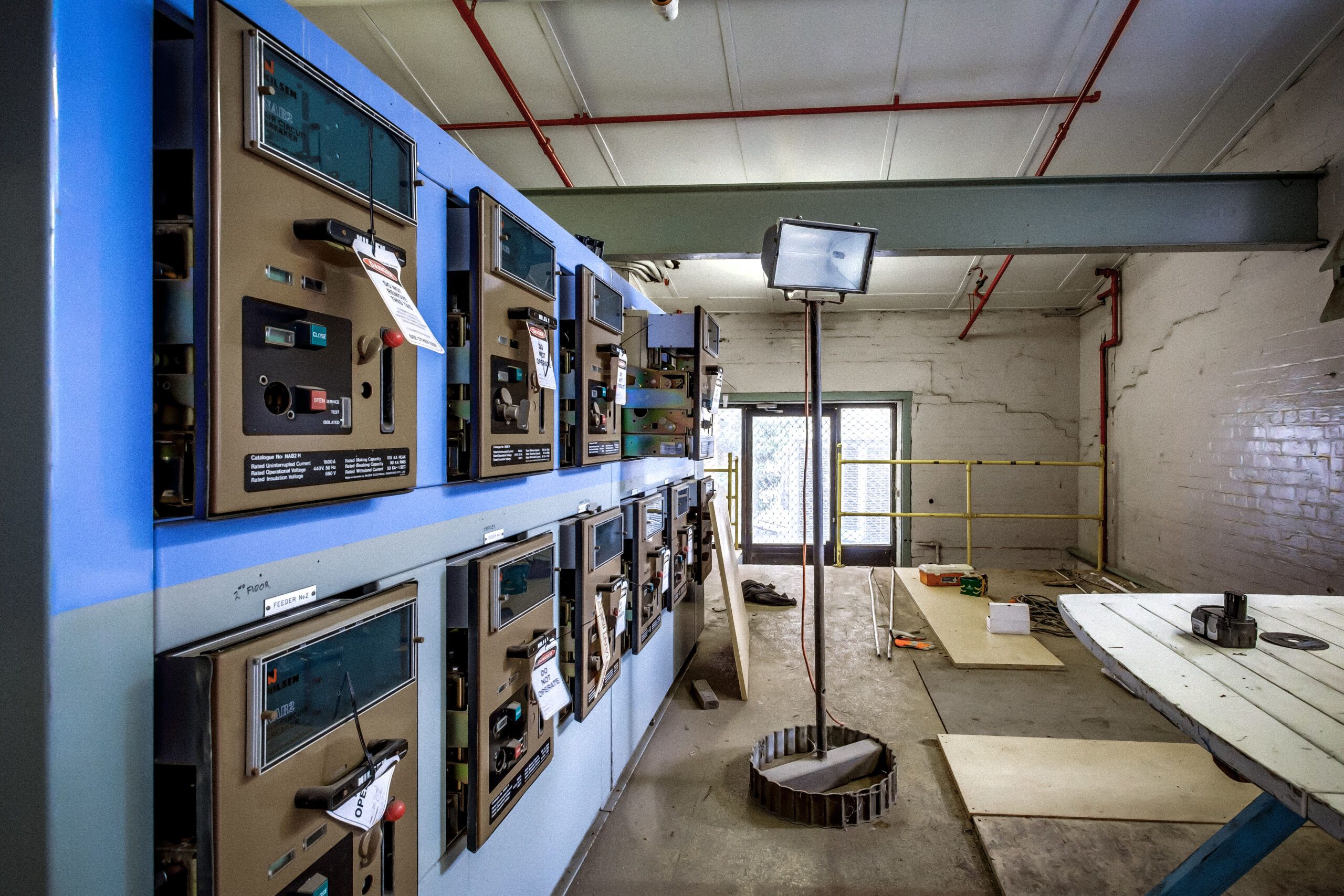
The power distribution system forms the backbone of any industrial facility’s electrical infrastructure, routing electricity from the utility service entrance through transformers, switchgear, motor control centres, and panel boards to individual loads.
Electrical designers determine the voltage hierarchy based on load requirements. Most Alberta industrial facilities receive power at 25kV or 13.8kV, step down through main transformers to 4.16kV for large motors (above 200 HP), then to 480V or 600V for smaller motors, and finally to 120/208V for lighting and receptacles. Voltage configurations vary by utility service territory.
Transformer sizing follows load analysis plus margins for future expansion. A 2,500 kVA unit typically costs $80,000-120,000 CAD installed, while a 5,000 kVA unit typically runs $150,000-200,000 CAD. Costs vary significantly by manufacturer, lead time, and market conditions, so verify current pricing when budgeting. Undersizing means replacing units mid-operation at roughly 3x the initial cost plus production losses. Oversizing by 50% wastes significant capital and yields no return.
Motor control centres (MCCs) house starters, variable-frequency drives (VFDs), and protective devices. When these systems malfunction, technicians rely on specialised industrial control system troubleshooting tools to diagnose faults efficiently. A typical MCC lineup for a mid-size facility ranges from $300,000 to $600,000 CAD, depending on configuration and hazardous-area ratings.
Protection and Safety Systems
An arc flash study analyses potential electrical hazards at each point in the power distribution system, calculating incident energy (measured in cal/cm²) to determine appropriate personal protective equipment requirements per CSA Z462 workplace electrical safety standards.
How much does an arc flash study cost, and why is it required?
An arc flash study typically costs $15,000-40,000 CAD for industrial facilities, with cost depending on the number of electrical buses and system complexity. Arc flash studies are required under CSA Z462 (referenced by provincial OH&S legislation) because, according to industry safety data, arc flash incidents represent a leading cause of electrical workplace fatalities. The study determines what protective equipment workers must wear when working near energised electrical equipment.
Short-circuit and coordination studies ensure that protective devices operate correctly under fault conditions. The device closest to the fault trips first, minimising the affected area while isolating the problem. These studies typically cost $20,000-50,000 CAD and take 4-8 weeks to complete.
For facilities handling flammable materials, hazardous area classification determines where explosive atmospheres might exist. Class I covers flammable gases and vapours, while Class II covers combustible dusts. Division 1 means hazardous conditions exist under normal operation, and Division 2 means only under abnormal conditions. Equipment costs in Division 1 areas typically run 3-5x standard equipment due to explosion-proof construction requirements.
The Electrical Design Process: Phases and Deliverables
Electrical design progresses through defined phases, each producing specific deliverables. Understanding this progression helps you set realistic expectations.
Conceptual Phase (4-8 weeks)
The conceptual phase develops preliminary load estimates, block diagrams showing major equipment interconnections, and rough sizing for transformers and switchgear. Expect ±30-40% accuracy on electrical cost estimates because process equipment isn’t finalised yet.
Engineering effort: Typically 200-500 hours ($30,000-75,000 CAD at $150/hour blended rate)
FEED Phase (3-6 months)
Front-End Engineering DesignFront-End Engineering Design is the engineering phase between conceptual studies and detailed design that defines project scope, cost estima... (FEED) is where electrical design takes definitive shape with equipment specifications suitable for procurement.
The single-line diagram (also called a one-line diagram) serves as the foundational document, illustrating the power distribution path from the utility connection through all major pieces of electrical equipment. These are specifically sized, rated components with defined characteristics.
Load analysis calculates total electrical demand by cataloguing every piece of equipment, its power requirements, operating characteristics, and diversity factors. A comprehensive load list contains 500 to 2,000 line items. Errors in the load list propagate through every downstream calculation.
How Long Does FEED Take, and What Does it Cost?
FEED typically takes 3-6 months for industrial projects, with an electrical engineering effort of 1,500-4,000 hours. At a $150/hour blended rate, electrical FEED costs $225,000 to $ 600,000 CAD. Actual costs vary by project complexity and firm. This investment typically proves worthwhile because addressing problems during FEED costs engineering hours rather than field rework at significantly higher rates.
FEED deliverables typically include:
- Definitive single-line diagrams
- Load list with demand factors
- Area classification drawings
- Major equipment specifications
- Preliminary cable routing study
- Cost estimate with ±15-20% accuracy
Detailed Design Phase (6-12 months)
Detailed design generates construction-ready documents. Cable schedules list every cable (power, control, instrumentation) with routing, conductor size, voltage rating, and termination points. A mid-size facility typically has 2,000 to 5,000 cables.
Conduit and cable tray routing drawings show physical pathways. Cable tray typically costs $40-80 CAD per linear foot installed, while conduit typically costs $25-50 per foot. A facility might have 5,000-15,000 linear feet of cable tray.
Engineering effort: Typically 4,000-12,000 hours ($600,000-1,800,000 CAD). First-time project managers often underestimate this. Detailed design takes 3-4 times as many hours as FEED because you’re specifying everything, not just major equipment.
How Electrical Design Integrates with Other Disciplines
Here’s something most “what is electrical design” articles ignore: electrical design doesn’t happen in isolation. The interfaces between disciplines cause more construction problems than any single discipline’s work. Firms like Vista Projects, which maintain multi-disciplinary capabilities under one roof, can often coordinate these interfaces more effectively than fragmented project teams.
Coordination Dependencies
Process engineering defines what the facility does. Electrical design depends on the process for motor loads, heater ratings, and control philosophy. Mechanical engineering specifies motors and HVAC equipment. Electrical needs motor data sheets early enough to size starters and cables, typically 4-6 weeks before the cable schedule is developed.
If mechanical changes a motor from 460V to 575V after cable schedules are complete, the electrical team must redo cable sizing, revise conduit fill calculations, potentially resize cable tray, and reissue 10-20 affected drawings. That’s 40-80 hours of rework, or roughly $6,000-12,000 CAD, plus construction delays if the cables have already been ordered.
Instrumentation and controls (I&C) engineering determines what instruments exist and where they’re located. Understanding the distinction between electrical design and electronics design helps clarify these overlapping scopes. Electrical design determines how instruments are powered, whether 120VAC for analysers, 24VDC for transmitters, or intrinsically safe barriers for instruments in hazardous areas.
Industry surveys suggest coordination failures between electrical and I&C happen on a significant portion of projects. Common problems include instruments specified without documented power requirements, control systems designed without adequate power supply, and cable routing conflicts. These problems surface during construction when fixing them costs substantially more than catching them during design reviews. Effective coordination must also account for CSA standards and provincial OH&S requirements, which mandate specific safety protocols for electrical work in hazardous areas and establish compliance documentation requirements that span multiple disciplines.
An honest assessment that might ruffle some feathers: based on project experience, most electrical-related construction rework stems from coordination failures, not electrical design errors. The electrical design itself might be technically correct with proper cable sizing, appropriate equipment ratings, and full code compliance. But if the electrical design assumes pipe routing that changed in Revision 12, you’re still tearing things apart in the field at construction labour rates.
What Makes Excellent Electrical Design?
Not all electrical engineering firms deliver equal quality. Here’s how to distinguish excellent work from adequate work.
Constructability: Can the design actually be built efficiently? Excellent electrical design considers installation access, cable pulling distances (cables typically can’t be pulled more than 100-150 feet without intermediate pull boxes), equipment clearances per CEC 2-308, and construction sequencing.
Code Compliance: Does the design meet CEC, provincial amendments, CSA Z462, and applicable IEEE standards? The code application requires engineering judgment. Qualified engineers understand not just what codes say, but why.
Coordination Quality: How thoroughly does electrical engineering coordinate with other disciplines? Ask about clash detection processes (Navisworks or equivalent), interdisciplinary review procedures, and conflict resolution. Firms with mature coordination processes often catch most conflicts in design, while less developed processes may miss a significant portion until construction.
Documentation Quality: Are drawings clear, complete, and consistent? Can someone unfamiliar with the project understand the design intent? Documentation quality matters during construction and for decades afterwards during operations.
Questions to ask electrical engineering service providers:
- Who stamps deliverables, and is that P.Eng. registered in your province?
- What’s your staff turnover rate?
- How do you coordinate with other disciplines?
- What’s your constructability review process?
- What’s included in scope, and what’s explicitly excluded?
Why Electrical Design Matters for Project Success
Electrical design is critical because getting it wrong has serious consequences measured in injuries, downtime, and dollars.
Safety: Improperly designed electrical systems create arc flash hazards, shock risks, and fire potential. A single serious electrical injury can cost $500,000 to $2,000,000 in direct and indirect costs, plus potential criminal charges under Bill C-45.
Reliability: Industrial facilities run on electricity. Without reliable power distribution, operations stop. Downtime costs range from around $10,000/hour for small manufacturing operations to $500,000/hour or more for petrochemical processing, and significantly higher for LNG export terminals.
Schedule: Electrical work appears on the critical path of most industrial projects. Cable tray installation, cable pulling, terminations, and testing account for a substantial portion of total construction labour hours. Design delays compress electrical construction. Compressed schedules mean overtime, errors, and shortcuts that surface during commissioning.
Cost: The electrical scope typically accounts for 8-15% of the total installed cost for industrial facilities, or roughly $4-7.5 million on a $50 million project. Within that, engineering services typically account for 10-15% of the electrical scope. The engineering fee is often 1-2% of the total project cost. Saving 20% on engineering while increasing construction costs 5% is a poor trade, yet it happens frequently.
Ensure a Safe, Compliant, and Efficient System from Day One
Schedule Your Industrial Electrical Design Consultation.
Conclusion
Electrical design in industrial engineering extends far beyond basic circuits and wiring. It encompasses the complete power infrastructure, enabling facilities to operate safely and efficiently. The process progresses through defined phases (conceptual, FEED, detailed design), with each phase producing specific deliverables that inform procurement and construction.
For project managers evaluating electrical engineering services: start by clearly defining your project phase and expected deliverables. Request proposals that break out hours by phase, not just lump sums. Engage electrical engineering early, during conceptual planning rather than at FEED kickoff, to influence decisions that affect the electrical scope. And prioritise firms demonstrating multi-disciplinary integration capabilities rather than treating electrical as an isolated scope.
The information in this guide reflects typical industry practices as of the time of publication. Costs, timelines, and regulatory requirements vary significantly by region, project type, and market conditions. Always verify current information with qualified professionals for your specific situation. Vista Projects provides integrated electrical engineering services across 13 energy markets, including petrochemical processing, mineral processing, biofuels, hydrogen, and carbon capture. With multi-disciplinary capabilities under one roof, our teams coordinate across disciplines to deliver constructable, code-compliant solutions that minimize field rework. Contact us to discuss your project’s electrical engineering requirements.