
Sustainable Aviation Fuel Market Overview
Sustainable Aviation Fuel is a drop-in replacement for conventional jet fuel produced from non-petroleum feedstocks. SAF meets ASTM D7566 specifications and blends with conventional Jet A or Jet A-1 without modifications to aircraft engines or airport fuelling infrastructure. The output is functionally identical to jet fuel with a substantially lower lifecycle carbon intensity.
Aviation accounts for roughly 2 to 3 percent of global carbon dioxide emissions and is one of the most difficult transport sectors to decarbonise. Batteries and hydrogen fuel cells are not yet viable for long-haul flight, which makes SAF the primary near-term decarbonization lever the aviation industry has. The result is a market with structural, regulation-backed demand growth.
The policy and commercial drivers are stacking up. The European Union’s ReFuelEU Aviation framework requires 2 percent SAF blending in 2025, scaling to 70 percent by 2050, with sub-mandates for synthetic SAF. The United States Inflation Reduction Act offers SAF tax credits between $1.25 and $1.75 per gallon, depending on lifecycle emissions performance. The United Kingdom mandates 2 percent SAF in 2025, scaling to 22 percent by 2040. ICAO’s CORSIA framework is moving into its mandatory phase from 2027. Canada’s Clean Fuel Regulations capture aviation fuel within a broader carbon intensity framework. Major airlines have signed offtake agreements totalling tens of billions of dollars in committed volume.
Vista Projects supports two distinct execution models in this market: greenfield SAF facilities across multiple ASTM-approved pathways, and brownfield refinery conversions or co-processing modifications.

Vista Projects Experience in SAF Markets
Vista Projects is a multi-discipline engineering firm and a leader in data-centric project execution. Our experience spans complex hydrocarbon processing facilities, brownfield refinery revamps, and hydrogen-integrated process units, all directly relevant to SAF project execution.
The execution risks in SAF are different from conventional capital projects. Project economics are tightly coupled to lifecycle carbon intensity scoring, tax credit eligibility, and offtake commitment timing. A FEED-stage capital cost surprise, a brownfield tie-in that runs longer than planned, or a schedule slip that misses a credit window can erode the financing case in ways that are harder to recover from than a conventional project overrun.
Our owner-controlled digital execution environment addresses these risks directly. Engineering, procurement, and construction data sit in a single source of truth accessible to the owner’s team in near-real time. Project controls run on the same data. The result is fewer surprises, tighter capital cost certainty, and protection of the financing case that justified the project in the first place. Our experience also covers utilities, tankage, modular execution, and brownfield revamp engineering, all common scope items on SAF projects.
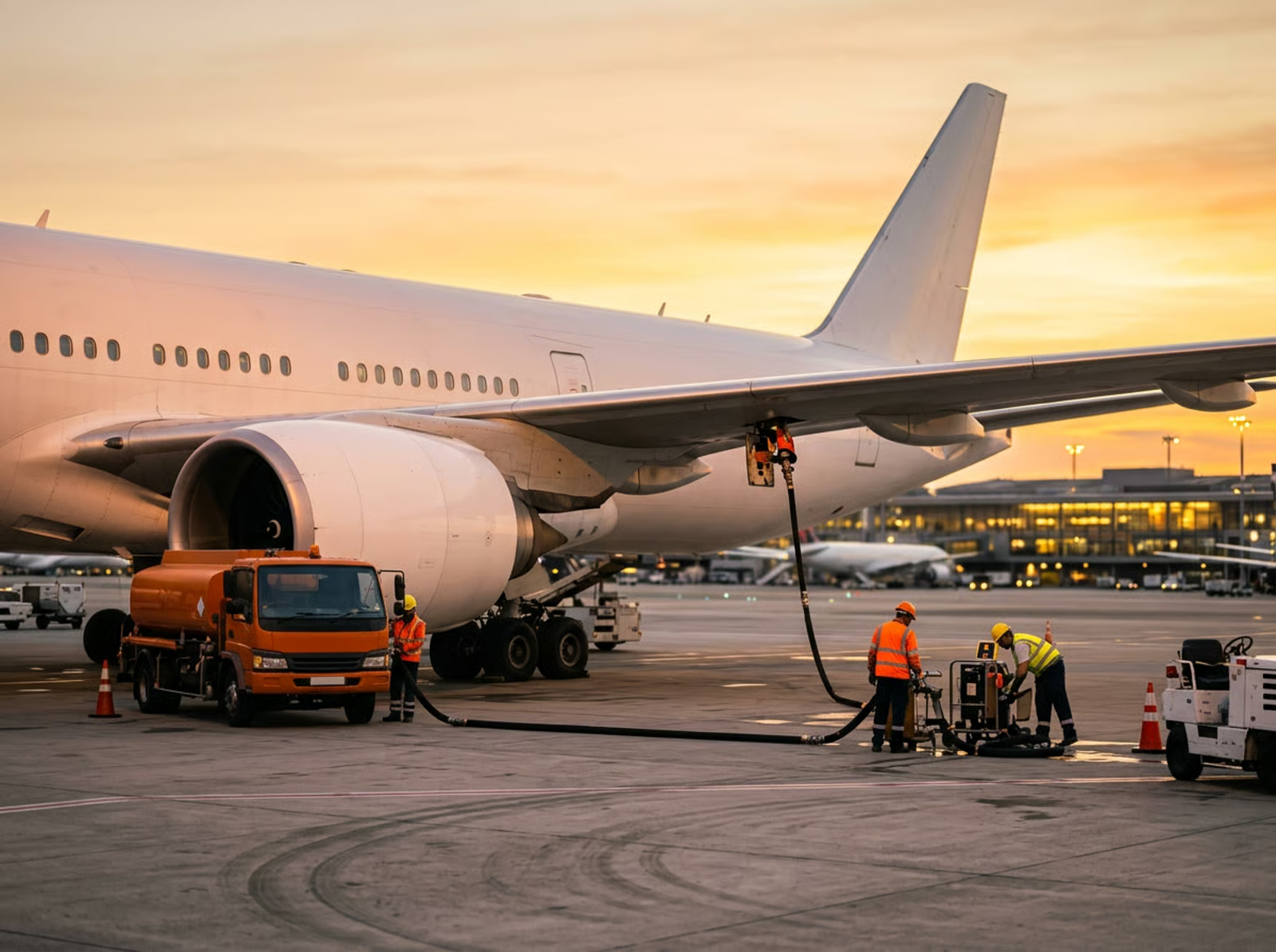
Vista Projects also has extensive experience with utilities, tankage, and well pad & pipeline development. Our project history includes long-term brownfield programs and multi-phase greenfield expansion projects.

Brownfield Refinery Conversion for SAF Production
Most North American SAF capacity coming online today is from refinery conversions or co-processing modifications, not greenfield builds. Existing renewable diesel facilities can be reconfigured to maximise jet-range product output. Conventional refineries can co-process renewable feedstocks alongside crude in selected units. Some facilities are converting whole hydrotreater trains to renewable service.
Recent and announced North American projects illustrate the trend. Calumet’s Montana Renewables facility is converting a former petroleum refinery into a renewable fuels producer with SAF capability. Imperial’s Strathcona renewable diesel project in Alberta is adding renewable fuels capacity at an existing refining site. Diamond Green Diesel’s Port Arthur expansion adds SAF capability at a major Gulf Coast renewables hub. Tidewater Renewables in Prince George, BC and Parkland’s co-processing work at Burnaby reflect similar Canadian activity.
Brownfield conversions carry execution challenges that greenfield projects do not. Utility re-balancing, hot-tap and tie-in planning, sequencing around continued operations, hydrogen rebalancing, and product slate transitions all require coordinated multi-discipline engineering. Vista Projects brings deep brownfield revamp experience to this work, supported by our data-centric execution model that keeps existing-plant data and revamp scope synchronised across the project team.
Sustainable Aviation Fuel Engineering Capabilities
Vista Projects delivers integrated engineering across the SAF project lifecycle, from concept selection through commissioning support. Our multi-discipline team covers process, mechanical, piping, civil, structural, electrical, and instrumentation and controls in-house. SAF projects benefit from this integration because pathway selection, hydrogen sourcing, product slate flexibility, and brownfield tie-ins all create cross-discipline coordination requirements that fragment quickly under document-centric execution models.
HEFA (Hydroprocessed Esters and Fatty Acids) Facilities
Engineering for the dominant commercial SAF pathway. Our scope covers feedstock pretreatment, hydrodeoxygenation, hydroisomerization, and fractionation systems. HEFA facility design overlaps strongly with renewable diesel production, and the same engineering approach supports facilities that swing product slate between renewable diesel and SAF based on market pricing.
Fischer-Tropsch SAF (FT-SPK)
Engineering for biomass-to-liquids and waste-to-liquids SAF facilities. The technical overlap with conventional Gas-to-Liquids execution is direct. Syngas conditioning, Fischer-Tropsch synthesis, and product upgrading all share design considerations with our broader GTL engineering scope.
Alcohol-to-Jet (ATJ) Facilities
Engineering for ethanol or isobutanol-based SAF production. The scope covers alcohol dehydration, oligomerisation, hydrogenation, and fractionation systems. ATJ pathways are commercialising through pioneer plants in the United States and elsewhere, with smaller-scale modular execution often preferred.
Power-to-Liquids and Synthetic SAF (PtL/eSAF)
Engineering support for emerging synthetic SAF pathways combining green hydrogen, captured carbon dioxide, reverse water gas shift, and Fischer-Tropsch synthesis. PtL is heavily incentivised under EU mandates and represents a longer-horizon growth segment within the broader SAF market.
Co-Processing and Brownfield Revamps
Engineering for facilities co-processing renewable feedstocks alongside conventional crude in existing refinery units. Tie-in design, utility re-balancing, hot-tap planning, and product slate transition planning are all core scope items. Our brownfield revamp expertise applies directly.
Hydrogen Integration for SAF
Every major SAF pathway is hydrogen-intensive. Engineering for hydrogen supply integration, including grey, blue, and green hydrogen sourcing, depending on project carbon intensity score targets. The hydrogen sourcing decision affects both capital structure and lifecycle emissions performance, which means it affects the financing case.
Front-End Engineering and FEED
Concept selection, feasibility studies, and FEED packages tuned to the financing case. SAF project economics depend on tax credit eligibility, lifecycle carbon intensity scoring, and offtake commitment alignment. All of these trace back to FEED-stage decisions. Our project controls group integrates estimating, scheduling, and risk analysis from the FEED stage forward, so the project enters detailed engineering with a realistic capital baseline and a defensible CI score.
All engineering work is performed under the responsible direction of professional engineers registered with APEGA and other relevant provincial regulators.
What Our SAF Clients Say

Talk to a Sustainable Aviation Fuel Engineering Expert
Strengthen your SAF project outcomes with the help of seasoned engineering experts. Whether you are evaluating a HEFA greenfield, scoping a refinery conversion to renewable jet fuel, sizing hydrogen supply for a planned facility, or working through pathway selection for a longer-horizon PtL build, the earliest engineering conversations are the most valuable ones.
Our business development team can connect you with the right engineering leads to discuss your project profile, walk through how our owner-controlled digital execution environment applies to SAF, and answer specific questions about pathway selection, brownfield scope, hydrogen integration, and FEED-stage capital cost discipline. Initial consultations are obligation-free.
Improve your project success with the help of seasoned experts

Tyler Elchuk
Business Development Director
Reduce SAF Project Risk with a Single Source of Truth
SAF project economics are tightly coupled to regulatory mechanics, offtake pricing, and tax credit eligibility. The cost of information silos in this market is not just rework. It is the risk of missing a tax credit window, recalculating a lifecycle carbon intensity score late in execution, or renegotiating an offtake commitment because the schedule slipped.
Our truth-based industrial engineering execution model facilitates:
Transparency about projects and assets across the full lifecycle
A collaborative problem-solving approach between the owner, engineering, and procurement teams
High-quality engineering designs grounded in synchronised, near-live project data
By structuring data in a single-source-of-truth (SSOT) environment, we simplify the digital transformation of your asset and help you make more informed decisions across the SAF project lifecycle. The outcome is a protected financing case, fewer commercial surprises, and a project that delivers on the economics that justified it.
Start Your SAF Project Conversation
The earliest engineering decisions on a SAF project carry the most weight. Pathway selection, feedstock strategy, hydrogen sourcing, and the choice between brownfield conversion and greenfield build all set the trajectory for capital cost, carbon intensity, and offtake commercial alignment. Engaging the right engineering partner at this stage protects the capital case before risk gets expensive.
Vista Projects works with operators, technology developers, and project sponsors across the SAF value chain. Our offices in Calgary, Houston, and Muscat give us reach into the major project geographies, with particular depth in the active Canadian and United States renewable fuels markets.
Book a consultation to discuss your SAF project.